
Focus on Feed Additions Global Supply
-13 Years in the Feed Additives Market.
Hotline+86 13821675082
Focus on Feed Additions Global Supply
-13 Years in the Feed Additives Market.

 Hotline +86 13821675082
Tel:+8613661236356
Email:sales@yeastpowderco.com
Add:Rm603 Central building, Xinmao Huayuan Park, Xiqing Dist., Tianjin China-300392
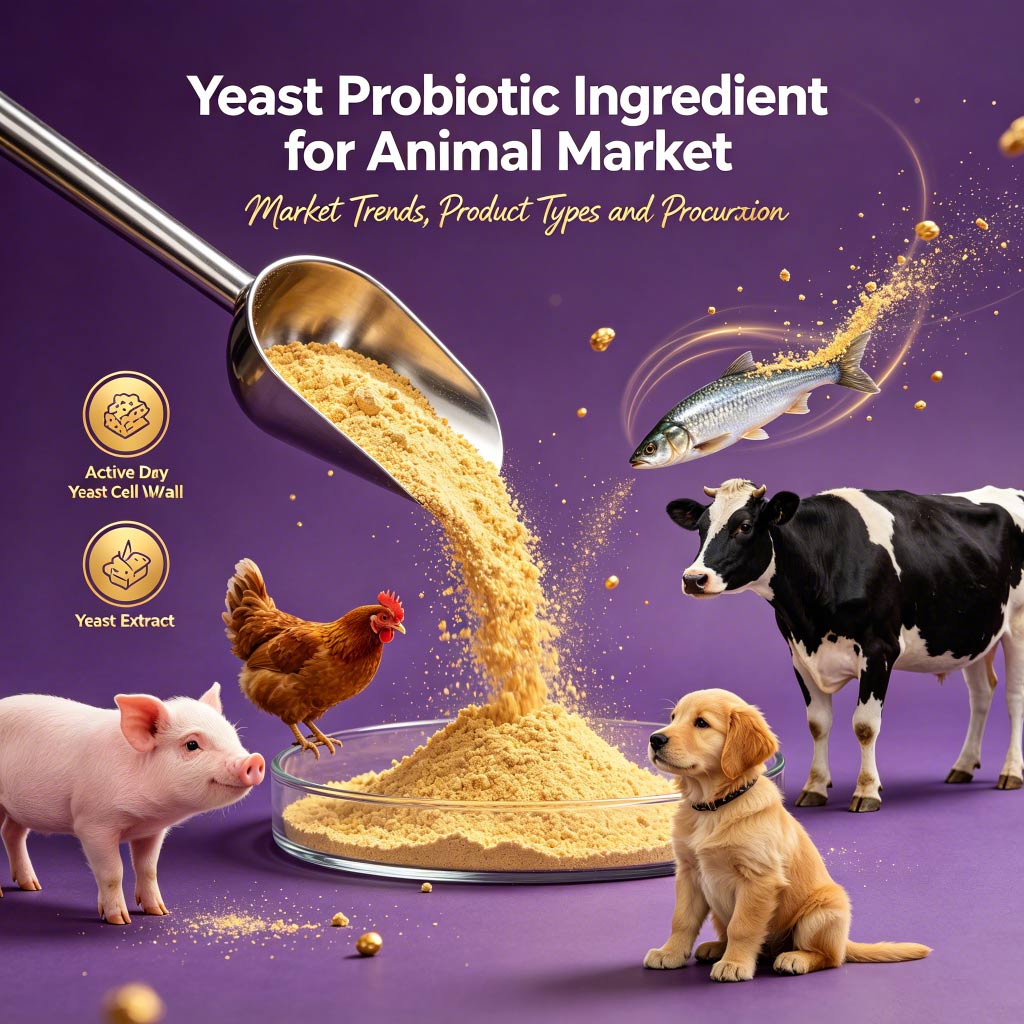
1. Introduction: Why Yeast Probiotics Are Moving from Niche to M...
Hotline+86 13821675082
Product Details
Ten years ago, yeast-based probiotics occupied a small corner of the animal feed additive market. They were used primarily by progressive swine producers and a handful of aquaculture researchers who understood the gut-health benefits of Saccharomyces cerevisiae. Today, that picture has changed almost beyond recognition. Yeast probiotic ingredients now appear in everything from commercial nursery pig diets and broiler grow-out rations to shrimp feed, dairy cow TMRs, and premium puppy food. The global market for yeast-based feed additives is growing at a compound annual rate of roughly 6%, outpacing the overall feed additive sector.
What drove this shift? Three converging forces: regulatory restriction of antibiotic growth promoters, growing scientific evidence for yeast gut-health mechanisms, and rising pressure on livestock producers to improve feed efficiency under margin compression. For feed mill procurement teams and formulators, the category has also become more complex — there are now active dry yeasts, inactivated brewer's yeasts, yeast cell wall preparations, yeast extracts, and yeast hydrolysates, each with different functional roles and price points. Understanding which product to use, for which species, at what inclusion rate, and from which supplier, is no longer optional.
This guide is written for feed industry professionals who need a clear, evidence-based overview of the yeast probiotic ingredient market — what it is, where it is going, how the products differ, and what to look for when evaluating suppliers.
The global market for yeast and yeast-derived feed ingredients is estimated at over 1.8 billion USD in recent years, with annual growth projected at approximately 6% through the end of the decade. Within this total, several subsegments are growing at markedly different rates:
Active dry yeast (probiotic): Growing fastest, at roughly 8–10% annually, driven by antibiotic substitution in swine and aquaculture.
Yeast cell wall (beta-glucan/MOS): Growing at 7–9%, driven by immune health and gut integrity positioning in pet food and young animal feeds.
Yeast extract and hydrolysate: Growing at 6–8%, used as flavor modifiers and nucleotide sources in feed and pet food.
Standard brewer's dried yeast (nutritional): Growing at 3–4%, primarily as a commodity protein source with price sensitivity.
The fastest growth is concentrated in the functional segments — active probiotic yeast and cell wall products — where buyers are selecting on CFU count, strain identity, and beta-glucan/MOS content rather than crude protein alone. This is a meaningful shift from a decade ago, when brewer's yeast was purchased almost exclusively as a protein supplement.
Geographically, demand is distributed across three major regions:
Asia-Pacific is the largest and fastest-growing market, driven by China, Vietnam, Thailand, Indonesia, and India. Rapid livestock intensification, antibiotic restriction policies, and a large aquaculture sector have made this the primary demand center. China alone accounts for a substantial share of global yeast probiotic consumption, both for domestic feed production and as a supply source for neighboring markets.
North America and Europe are mature markets with high per-unit value products. European feed formulators have used yeast probiotics for decades, and the EU ban on antibiotic growth promoters (effective since 2006) created an early and sustained demand base. North America has followed more recently, driven by VFD (Veterinary Feed Directive) regulations and retailer sustainability requirements.
Latin America is an emerging growth market, particularly Brazil and Mexico, where swine and poultry production continues to expand and producers are seeking antibiotic reduction solutions without sacrificing performance.
The supply side is equally layered. At the top are a small number of established yeast culture and probiotic brands with proprietary strains, significant R&D investment, and premium pricing. Below them are medium-sized suppliers producing standard active dry yeast and yeast derivatives with consistent quality. At the bottom are commodity brewer's yeast processors buying brewery by-products and drying them with minimal standardization.
For buyers, this means the category spans everything from research-backed, strain-specific probiotics to generic dried yeast powder. The price difference between these tiers can be 3–5x per kilogram — and the performance difference can be equally large, depending on the application.
The single largest demand driver for yeast probiotic ingredients has been the global restriction of antibiotic growth promoters (AGPs). The European Union banned AGPs in 2006, creating the first large-scale market for alternative gut health solutions. The United States followed with the Veterinary Feed Directive in 2017, placing medically important antibiotics under veterinary oversight. China banned AGP use in feed in 2020. Vietnam, Thailand, and other Southeast Asian countries have implemented progressively stricter restrictions.
This regulatory shift did not create yeast probiotics out of nothing — but it dramatically expanded their addressable market. Where antibiotic growth promoters once provided broad-spectrum gut health protection, producers now need natural alternatives that can maintain growth performance and reduce disease pressure.
Among the available alternatives — organic acids, essential oils, bacterial probiotics, enzyme preparations, and yeast products — yeast-based solutions have several practical advantages:
Survival through feed processing: Yeast cells have thick cell walls that survive pelleting temperatures (up to 75°C) far better than most bacterial probiotics.
Stability in storage: Dried yeast is shelf-stable at room temperature for 18–24 months, unlike some bacterial probiotics that require cold chain.
Dual mechanism: Active yeast provides probiotic gut action, while cell wall components (beta-glucan, MOS) provide immune and pathogen-binding benefits — in one ingredient.
Species agnostic: The same yeast strain works across swine, poultry, aquaculture, and ruminants, simplifying procurement for multi-species feed mills.
Regulatory acceptance: Saccharomyces cerevisiae is generally recognized as safe (GRAS) in the U.S., listed in the EU feed additive catalog, and recognized by NAFIQAD in Vietnam and equivalent bodies in other markets.
Beyond antibiotic restriction, several secondary trends are reinforcing yeast probiotic demand:
Young animal nutrition: As swine and poultry genetics produce larger litters with lower birth weights, the nutritional and immunological needs of neonatal animals have driven demand for nucleotides, beta-glucan, and gut-supporting ingredients — all naturally present in yeast.
Pet humanization: Pet food producers have adopted yeast derivatives as functional ingredients for gut health, skin and coat, and immune support, creating a high-margin demand pull.
Aquaculture intensification: High-density shrimp and fish production requires disease management tools that do not rely on antibiotics — MOS and active yeast are core components of modern aquaculture gut health programs.
Ruminant performance: Active yeast has a well-documented role in stabilizing rumen pH, improving fiber digestion, and supporting milk production in dairy cows — a segment that has grown steadily.
One of the most common sources of confusion in this market is that "yeast probiotic" is used as an umbrella term covering products that function very differently. Understanding the categories is essential for correct procurement.
Active dry yeast consists of live, dried Saccharomyces cerevisiae cells with a guaranteed viable count — typically 10–20 billion CFU per gram. When consumed, the live cells survive gastric transit and exert probiotic effects in the gut: competing with pathogens for adhesion sites, producing metabolites that support beneficial bacteria, and modulating immune response.
Key purchasing parameters: viable cell count (CFU/g), strain identity, moisture (≤6% preferred), packaging (hermetic, nitrogen-flushed preferred), and shelf life. Active dry yeast is used at 50–500 g per metric ton of complete feed depending on species and production stage.
This is a brewing by-product yeast that has been heat-inactivated. It contains no live cells (0 CFU) but provides nutritional value: 40–50% crude protein, B vitamins, amino acids, and residual cell wall components. As we detailed in our analysis of crude protein alone does not determine functional value, two products both labeled 45% CP can deliver very different beta-glucan and MOS levels.It is used as a functional nutritional ingredient at 1–5 kg per ton, not as a probiotic.
Key distinction: buying inactive brewer's yeast as a "probiotic" is a category mismatch. It provides nutrition but no live probiotic action. Conversely, paying probiotic prices for a product labeled "active" when it is actually inactive is a quality risk.
Yeast cell wall is the isolated cell wall fraction of yeast, typically rich in beta-glucan (30–50%) and mannan oligosaccharides (MOS, 20–30%). It is produced by disrupting yeast cells and separating the cell wall from cytoplasmic contents. It is used specifically for immune modulation and pathogen binding, typically at 50–200 g per ton.
Key purchasing parameters: beta-glucan content, MOS content, and the ratio between them. These products are higher-priced per kilogram but used at lower inclusion rates.
Yeast extract is the soluble cytoplasmic fraction of yeast, rich in free amino acids, peptides, and nucleotides. It is produced by autolysis or enzymatic hydrolysis. In feed, it is used as a palatability enhancer and nucleotide source, particularly in young animal and aquaculture feeds. Yeast hydrolysate is a related product with controlled degree of hydrolysis. These are specialty ingredients with specific functional roles rather than general probiotic supplements.
| Product Type | Live Cells | Primary Function | Typical Inclusion | Price Level |
|---|---|---|---|---|
| Active Dry Yeast | 10–20B CFU/g | Probiotic gut action | 50–500 g/ton | Medium-high |
| Inactive Brewer's Yeast | 0 CFU/g | Protein, B vitamins, nutrition | 1–5 kg/ton | Low-medium |
| Yeast Cell Wall | 0 CFU/g | Immune, pathogen binding | 50–200 g/ton | High |
| Yeast Extract | 0 CFU/g | Palatability, nucleotides | 100–500 g/ton | High |
Swine is the largest single application segment for yeast probiotics. The highest-value use is in nursery piglets immediately after weaning, when gut flora disruption and post-weaning diarrhea are most acute. Active dry yeast at 200–500 g/ton supports gut integrity, reduces diarrhea incidence, and improves feed intake. In sows, yeast supplementation during gestation and lactation improves milk composition, reduces constipation, and supports litter uniformity. Finishing pigs receive lower inclusion rates (50–100 g/ton) as part of a general gut health program.
In broilers, yeast probiotics at 100–200 g/ton support gut integrity during the 35–42 day grow-out, particularly during stress periods such as heat and vaccination. Benefits include improved feed conversion ratio and reduced mortality. For specialty avian applications, see our detailed guide on brewer's yeast for racing pigeons, which covers stage-specific dosing and product selection. In layers, 100–150 g/ton supports shell quality and production consistency. In breeders, higher inclusion (150–250 g/ton) supports hatchability and chick quality.
Aquaculture is one of the fastest-growing segments for yeast probiotics. In Pacific white shrimp (the dominant farmed species in Southeast Asia and Latin America), active yeast and cell wall products at 200–400 g/ton support Vibrio management, gut health, and survival. The challenge in aquafeed is processing: extrusion temperatures of 120–130°C kill live yeast, so active dry yeast must be applied post-extrusion as a coating. Inactive cell wall products can be added directly during extrusion since they have no viable cells to lose. For regional procurement guidance, see our guide on active dry yeast procurement for Vietnamese feed mills.
In dairy cows, active yeast has a long research history demonstrating stabilized rumen pH, improved fiber digestion, and increased milk yield — particularly during early lactation when rumen function is under pressure. Inclusion rates are typically 5–20 g per head per day. In beef cattle, yeast supports growth performance during finishing and stress periods such as weaning and transport.
The pet food segment is the highest-margin application for yeast derivatives. Yeast cell wall products (beta-glucan/MOS) are used for immune support; inactive brewer's yeast is used for B-vitamin and skin-and-coat benefits; yeast extract is used as a palatability enhancer. Pet food formulators often combine multiple yeast fractions in a single product line, making this a sophisticated but rewarding market segment.
The two non-negotiable parameters for active dry yeast are viable cell count and strain identity. Label CFU claims must be verified against actual test results — and viability declines over time. A product labeled 20B CFU/g that has been stored for 6 months at 35°C may deliver 12B CFU/g. Buyers should require production-date-stamped COAs and consider tropical storage viability data.
Strain identity matters because different Saccharomyces cerevisiae strains have different gut survival and colonization properties. A supplier that cannot name the strain is selling a generic product, not a probiotic.
For nutritional brewer's yeast, crude protein (≥40–45%), moisture (≤8%), and ash (≤5–8%) are baseline parameters. But for feed formulations that rely on functional components, beta-glucan and MOS content on the COA are more informative than protein alone. Acid-soluble protein ratio indicates autolysis degree — higher values mean better digestibility but reduced cell wall integrity.
Cell wall products should be purchased on beta-glucan and MOS percentages, not on protein. A product that guarantees 30% beta-glucan and 20% MOS is a different ingredient from one that only lists crude protein. These products are typically sold at a premium and used at low inclusion rates — the functional content is the entire basis of the purchase decision.
Across all yeast product categories, buyers should verify: Salmonella negative, E. coli negative, heavy metal limits (Pb, As), mycotoxin limits (aflatoxin, DON, zearalenone), and moisture appropriate to the product type. Each batch should come with a COA containing actual test values, not just "compliant" statements.
The category spans products from baking-grade yeast repackaged as feed probiotics to research-validated proprietary strains. The CFU count, gut survival rate, and field performance can vary by an order of magnitude. Evaluating based on price per kilogram alone obscures these differences.
A product with 100 billion CFU/g is not inherently better than one with 20 billion CFU/g. What matters is CFU delivered at the gut — after gastric transit, bile exposure, and feed processing. A well-encapsulated or stress-tolerant strain at 20B may outperform a generic baking yeast at 100B. Strain selection and viability retention matter more than headline CFU numbers.
Yeast extract is a soluble, flavoring/nutritional product with no live cells and no cell wall. It does not provide probiotic action. Buying it as a probiotic is a category error, though it is a legitimate ingredient in its own right.
A COA that only lists crude protein and moisture tells you almost nothing about whether the product will deliver probiotic or immune benefits. For functional products, the COA must include the relevant functional parameters — CFU for active yeast, beta-glucan and MOS for cell wall products, acid-soluble protein for nutritional yeast.
As in any functional ingredient category, the lowest-priced option typically sacrifices on viability, strain consistency, or documentation. The correct metric is effective cost per delivered functional unit — whether that is CFU, beta-glucan gram, or MOS gram — not price per kilogram. For a deeper dive into supplier evaluation criteria, including batch stability and AAFCO compliance, see our dedicated analysis.
When evaluating yeast probiotic suppliers, we recommend a six-dimension assessment:
Product category clarity: Does the supplier clearly distinguish active yeast, inactive yeast, cell wall, and extract? Do they sell what you actually need?
Functional parameter testing: Can they provide CFU, beta-glucan, MOS, and acid-soluble protein data per batch — not just protein and moisture?
Strain consistency: Do they use a consistent strain across batches? Can they identify it?
Processing quality: Spray drying vs. drum drying, packaging quality, moisture control, post-drying homogenization.
Compliance and documentation: ISO, HACCP, FDA registration, country-specific import approvals, COA completeness.
Supply reliability: Capacity, delivery history, MOQ flexibility, and technical support.
Suppliers scoring well across all six dimensions are rare and worth forming long-term relationships with. Those scoring poorly on functional testing or strain consistency will likely cause formulation and performance problems downstream.
Anqirui supplies a range of yeast-based feed ingredients to the global animal nutrition market, supported by 13 years of export experience and a controlled production base in northern China.
Our active dry yeast (feed grade) delivers ≥20 billion CFU/g at manufacture, with a selected feed-grade Saccharomyces cerevisiae strain, ≤6% moisture, and nitrogen-flushed foil packaging for tropical market viability. Our inactive brewer's yeast powder guarantees ≥45% crude protein with documented beta-glucan and MOS content per batch. We also supply yeast cell wall fractions with specified beta-glucan and MOS concentrations.
Every batch ships with a COA containing actual test values for all relevant parameters, microbial safety testing, and heavy metal analysis. We support trial orders, provide export documentation including Form E for ACFTA preferential tariffs, and work with feed mills in Vietnam, the Philippines, Indonesia, Mexico, Colombia, and the United States.
For product specifications, samples, and pricing:
Email: sales@yeastpowderco.com
WhatsApp: +86 138 2167 5082
Website: www.yeastpowderco.com
The yeast probiotic ingredient market has matured from a niche supplement category into a mainstream component of modern animal nutrition. The growth drivers — antibiotic restriction, young animal nutrition, aquaculture intensification, and pet humanization — are structural and will continue to shape demand. But the market has also become more complex, with multiple product categories serving different functional roles.
For feed industry professionals, the key takeaway is simple: match the product category to the functional need, verify the parameters that actually matter (CFU, strain, beta-glucan, MOS), and evaluate suppliers on functional testing and consistency rather than price alone. The feed mills that get this right will have more consistent formulations, fewer performance surprises, and stronger positions as the market continues to professionalize.
Q: What is the difference between active dry yeast and brewer's dried yeast in feed?
A: Active dry yeast contains live cells (10–20 billion CFU/g) that function as probiotics in the gut. Brewer's dried yeast is heat-inactivated and contains no live cells, providing protein, B vitamins, and nutritional value. They are different products at different price points, selected based on whether the goal is live probiotic action or nutritional supplementation.
Q: At what inclusion rates should yeast probiotics be used in animal feed?
A: Active dry yeast is typically used at 50–500 g per metric ton, depending on species and production stage (nursery pigs: 200–500 g/ton; broilers: 100–200 g/ton; shrimp: 200–400 g/ton). Inactive brewer's yeast is used at 1–5 kg/ton as a nutritional ingredient. Yeast cell wall products are used at 50–200 g/ton for immune and gut support.
Q: Can yeast probiotics survive feed pelleting?
A: Active dry yeast generally survives standard pelleting at die temperatures up to 75°C with acceptable viability loss. For high-temperature extrusion (120–130°C, typical in aquafeed), live yeast should be applied post-extrusion as a coating, or an inactive cell wall product should be used instead.