
Focus on Feed Additions Global Supply
-13 Years in the Feed Additives Market.
Hotline+86 13821675082
Focus on Feed Additions Global Supply
-13 Years in the Feed Additives Market.

 Hotline +86 13821675082
Tel:+8613661236356
Email:sales@yeastpowderco.com
Add:Rm603 Central building, Xinmao Huayuan Park, Xiqing Dist., Tianjin China-300392
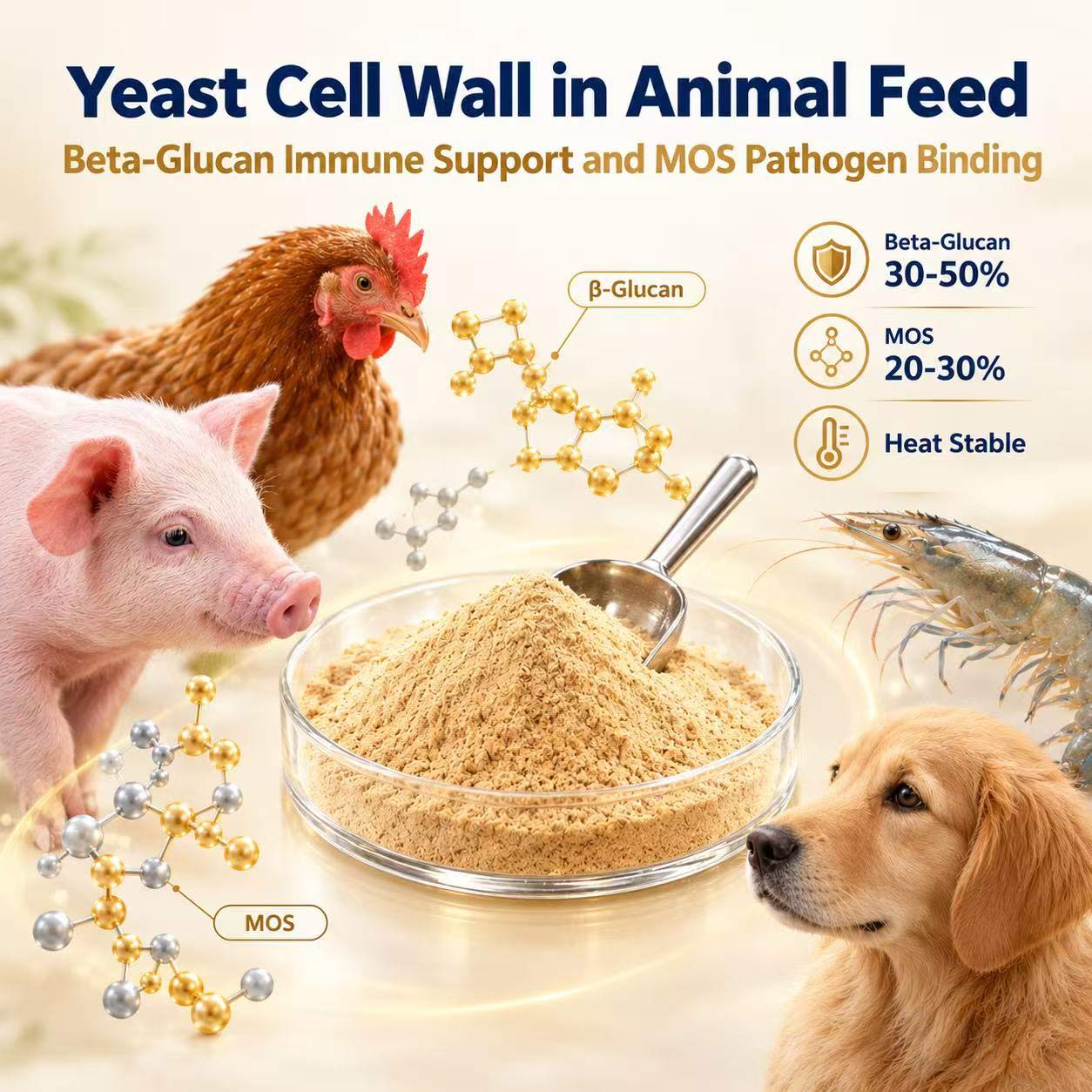
What yeast cell wall does in animal feed: beta-glucan immune mod...
Hotline+86 13821675082
Product Details
Twenty years ago, yeast cell wall was considered a waste fraction. When brewer's yeast was processed for protein or extract recovery, the insoluble residue — the cell wall material left after cytoplasmic removal — was often discarded, sold as low-value feed filler, or blended back into commodity yeast powder at a fraction of the price. Today, that same material is one of the fastest-growing functional ingredients in animal nutrition, commanding prices 3–5 times higher than standard brewer's dried yeast, and generating strong demand from swine, poultry, aquaculture, and pet food formulators.
The reason for this transformation is a gradual but decisive shift in understanding. What was once seen as inert fiber is now recognized as a biologically active material with two major functional components: beta-glucan, a well-documented immunomodulator, and mannan oligosaccharides (MOS), a natural pathogen-binding agent. Together, these two fractions provide gut health and immune support that complements — and in some applications replaces — antibiotic growth promoter use.
For feed mill procurement teams and formulators, yeast cell wall now occupies a distinct position between bulk nutritional ingredients and high-end specialty additives. It is not a probiotic (it contains no live cells). It is not a protein supplement (its protein content is secondary). It is a targeted functional ingredient purchased on the basis of beta-glucan and MOS content — and the gap between a well-characterized cell wall product and a commodity by-product is substantial.
This guide explains what yeast cell wall is, how its two key components function in the animal gut, where it delivers measurable value across species, and what parameters buyers should verify on every COA.
Yeast (Saccharomyces cerevisiae) is a single-celled fungus. Its cell wall is a layered, complex structure that makes up approximately 15–25% of the cell dry weight. The wall is not a uniform barrier — it is a multi-layered composite with distinct chemical components, each with different functional properties.
The outermost layer is primarily mannoprotein — proteins heavily glycosylated with mannose sugar chains. This layer is responsible for the "MOS" fraction: the mannan oligosaccharides that become exposed and available for binding when the cell wall is processed. Beneath the mannoprotein layer lies a dense network of beta-glucan — a long-chain glucose polymer arranged in both beta-1,3 and beta-1,6 linkages. This glucan layer provides structural rigidity and is the primary immunomodulatory component. A thin inner layer of chitin provides additional structural support.
When yeast cells are disrupted (by autolysis, mechanical disruption, or enzymatic treatment), the soluble cytoplasmic contents — proteins, amino acids, vitamins, nucleotides — are separated from the insoluble cell wall. The cell wall fraction, typically 15–25% of the original cell dry weight, is what is sold as "yeast cell wall," "yeast wall," or "MOS-beta-glucan product."
Beta-glucan is a polysaccharide made of glucose units linked by beta-glycosidic bonds. In yeast, the primary form is a branched polymer of beta-1,3-linked glucose chains with beta-1,6 branch points. This specific branched structure is biologically significant — linear beta-glucans from cereal sources (oats, barley) have different structures and different immunological activity than yeast-derived branched beta-glucan.
The molecular weight, branching pattern, and solubility of beta-glucan vary depending on the yeast growth conditions, disruption method, and extraction process. Products labeled "yeast beta-glucan" can range from 20% to over 70% pure glucan — and the biological activity depends on both concentration and structural integrity. A high-purity, well-extracted beta-glucan preparation at 50% content can be more active than a crude cell wall product at 30% content, because the extraction process preserves the molecular structure that immune receptors recognize.
MOS is derived from the mannoprotein outer layer of the yeast cell wall. The mannose sugar chains on these proteins, when released or exposed during cell wall processing, become mannooligosaccharides — short chains of mannose units that structurally resemble the carbohydrate receptors on the surface of intestinal epithelial cells.
This structural resemblance is the basis of MOS's pathogen-binding function. Certain pathogenic bacteria — particularly Gram-negative organisms such as Salmonella, E. coli, and Vibrio — attach to the gut lining using type-1 fimbriae that bind specifically to mannose residues. When MOS is present in the gut lumen, these pathogens bind to the MOS instead, and are flushed out with digesta rather than colonizing the intestinal wall.
MOS content in commercial yeast cell wall products typically ranges from 20% to 40%, depending on the raw material and extraction process. The ratio of beta-glucan to MOS in a product depends on which layer of the cell wall has been enriched during processing.
Because yeast cell wall still contains residual protein (largely from the mannoprotein layer), commercial products typically list crude protein at 20–40%. This number is often misinterpreted. A cell wall product at 35% crude protein is not a protein source — the protein is structural, not nutritional. The buyer should not be purchasing cell wall for its protein content; the relevant numbers are beta-glucan and MOS percentages.
This is a point that connects directly to a broader pattern in yeast ingredient procurement: as we detailed in our analysis of crude protein alone does not capture yeast functional value, the most important parameters for any functional yeast product are the specific active components — not the bulk protein number on the COA.
Beta-glucan is a recognized biological response modifier. In the animal gut, it is recognized by pattern recognition receptors — particularly Dectin-1 and complement receptor 3 (CR3) — on the surface of innate immune cells including macrophages, neutrophils, and dendritic cells. When beta-glucan binds to these receptors, it primes the immune cells for faster and stronger response to subsequent challenge. This is sometimes described as "training" the innate immune system.
The mechanism is distinct from vaccination. Vaccination trains the adaptive immune system — specific antibodies and T-cell responses against a specific pathogen. Beta-glucan acts on the innate immune system, which is the first line of defense and does not require specific pathogen recognition. The result is a more rapid and robust response to any bacterial, viral, or inflammatory challenge, rather than targeted protection against one organism.
In practical terms for animal production, this means that beta-glucan supplementation can support immune competence during periods when the animal is under immunological stress: weaning in piglets, vaccination in poultry, transfer between ponds or cages in aquaculture, and environmental stress such as heat or overcrowding.
The immune-modulatory effect of yeast beta-glucan has been documented across multiple species and production conditions. In piglets, beta-glucan supplementation around weaning has been associated with improved immune response markers, reduced post-weaning inflammation, and better growth performance. In poultry, it has been linked to enhanced macrophage activity and improved resistance to Salmonella challenge. In fish and shrimp, beta-glucan is widely used as an immunostimulant — particularly in aquaculture, where adaptive immunity is less developed and innate immune support is critical.
It is important to note that beta-glucan is not a drug. It does not directly kill pathogens or treat disease. It supports the animal's own immune system so that the animal is better prepared to respond naturally. The effects are typically measured as improved survival, reduced medication requirements, and more consistent growth — not as dramatic clinical cures.
Not all beta-glucan products are equally active. The immunological activity of beta-glucan depends on its molecular structure: the degree of branching, molecular weight distribution, solubility, and how gently it was extracted. Harsh chemical extraction (strong acid or alkali) can denature the molecular structure and reduce receptor recognition. Physical or enzymatic extraction methods that preserve the native structure produce more active beta-glucan at lower inclusion rates.
This is why beta-glucan content on a COA is not sufficient — the method of extraction and the structural integrity of the glucan matter. A product at 50% beta-glucan extracted by gentle enzymatic process may outperform a product at 60% beta-glucan extracted by harsh chemical treatment. The buyer should ask about the extraction method, not just the percentage.
The mechanism of MOS is fundamentally different from beta-glucan. While beta-glucan acts on the host's immune system, MOS acts directly on the pathogen — preventing it from attaching to the intestinal wall in the first place.
Many enteric pathogens — including Salmonella enterica, pathogenic E. coli, and certain Vibrio species — express hair-like surface structures called type-1 fimbriae. These fimbriae contain a protein (FimH) that specifically binds to mannose residues on the surface of intestinal epithelial cells. Once bound, the pathogen can colonize, invade, and cause infection.
MOS provides an alternative binding site. Because MOS is itself a polymer of mannose, the FimH protein on the pathogen's fimbriae binds to MOS in the gut lumen. The pathogen-MOS complex cannot attach to the gut wall and is eliminated with the feces. The pathogen is not killed — it is simply prevented from establishing infection.
This anti-adhesion mechanism is particularly valuable in young animals and intensively farmed species where pathogen pressure is high and antibiotic reduction is required. It is also complementary to probiotic active yeast, which works by competitive exclusion — occupying adhesion sites so pathogens cannot bind. Together, MOS and active yeast provide two layers of gut defense: physical competition (probiotic) and pathogen decoy (MOS).
Beyond pathogen binding, MOS also functions as a prebiotic — a substrate that selectively supports the growth of beneficial gut bacteria, particularly Bifidobacterium and Lactobacillus species. These beneficial bacteria ferment MOS into short-chain fatty acids (SCFAs) such as butyrate, which nourishes colonocytes, maintains gut barrier integrity, and creates an acidic environment that suppresses pathogen growth.
This dual action — pathogen binding plus prebiotic support — is why MOS is considered more versatile than either a pure pathogen blocker or a simple prebiotic. It addresses both sides of the gut health equation: removing pathogens and promoting beneficial bacteria.
Aquaculture is the species where MOS has the most established and intensive use. In Pacific white shrimp (Litopenaeus vannamei) and black tiger shrimp (Penaeus monodon), pathogenic Vibrio species — particularly Vibrio parahaemolyticus (the cause of early mortality syndrome, EMS/AHPND) and Vibrio harveyi — are the primary disease threat. These Vibrio species use mannose-sensitive hemagglutinin (MSH) fimbriae to attach to the shrimp's gastrointestinal tract and hepatopancreas.
MOS supplementation in shrimp feed at 200–500 g per metric ton has been shown in field and trial conditions to reduce Vibrio load in the gut, improve survival rates, and reduce the incidence of EMS/AHPND. This is one reason why MOS is now a standard component in commercial shrimp feed formulations across Southeast Asia and Latin America.
In fish — particularly tilapia, salmon, and catfish — MOS supports gut health during intensive culture and reduces the impact of enteric pathogens under high-density conditions.
Swine is the largest market for yeast cell wall products. The highest-value application is in weaning piglets — typically 7–25 kg — where the combined stress of separation from the sow, diet change from milk to solid feed, and exposure to new pathogens creates a perfect storm for intestinal dysfunction. Post-weaning diarrhea, reduced villus height, and impaired immune development are the norm in commercial pig production.
Yeast cell wall at 50–200 g per metric ton in nursery feed supports this transition through both beta-glucan immune priming and MOS pathogen binding. The beta-glucan primes the piglet's naive immune system for faster response to environmental pathogens. The MOS binds pathogenic E. coli and Salmonella before they can colonize the immature gut. Together, these effects reduce diarrhea incidence, improve feed intake, and support more uniform growth through the nursery phase.
In sows, yeast cell wall at 100–200 g per metric ton in gestation and lactation feed supports maternal immunity transfer to piglets through colostrum. There is also evidence that sow gut health improves milk quality and reduces farrowing-related stress.
In poultry, yeast cell wall serves two key functions. First, MOS binds Salmonella — a critical concern for broiler producers and layer operations where Salmonella contamination affects both food safety and production performance. Second, beta-glucan supports macrophage activity and immune competence during vaccination and stress periods.
For broilers, cell wall inclusion at 50–150 g per metric ton supports gut integrity and reduces enteric disease pressure — particularly coccidiosis-related stress and necrotic enteritis risk. In layers, it supports egg quality and reduces the incidence of Salmonella-positive flocks. In breeders, it contributes to hatchability and chick quality through improved breeder gut health.
One practical advantage in poultry is that yeast cell wall is heat-stable — it contains no live cells and survives standard pelleting and even extrusion processes without loss of function. This makes it easier to use in poultry feed than live yeast probiotics, which require post-pellet application at higher processing temperatures.
As noted above, aquaculture is the most MOS-intensive application. In shrimp production, cell wall products at 200–500 g per metric ton are used as a standard component of gut health and disease management programs. The primary target is Vibrio species — V. parahaemolyticus, V. harveyi, V. vulnificus — which cause acute hepatopancreatic necrosis disease, luminescent vibriosis, and mass mortality events in intensive shrimp farming.
Because cell wall products contain no live cells, they can be added directly during the extrusion process — unlike active dry yeast, which must be applied post-extrusion as a coating. This simplifies feed mill operations and makes cell wall products the preferred choice for commercial aquafeed production.
In fish species including tilapia, catfish, and salmon, yeast cell wall at 100–300 g per metric ton supports gut health and disease resistance during intensive culture, particularly in recirculating aquaculture systems (RAS) where pathogen pressure is high.
In ruminants, yeast cell wall has a more specialized role. In dairy cows, MOS and beta-glucan support rumen health and udder immune defense — reducing somatic cell count in milk and supporting mastitis resistance. In calves, cell wall supplementation around weaning supports gut health and reduces diarrhea incidence during the transition from milk to solid feed. Inclusion rates are typically 5–20 grams per head per day for adult cattle, adjusted for body weight and production stage.
Pet food is the highest-margin application for yeast cell wall. In dog and cat diets, beta-glucan and MOS are positioned as functional ingredients for immune support, gut health, and food allergy management. Premium pet food brands include cell wall products at 0.1–0.5% inclusion — low in percentage but high in margin, because pet consumers are willing to pay for documented immune and digestive benefits.
The single most important parameter for yeast cell wall products is beta-glucan content. Commercial products range from 20% to over 60% beta-glucan, depending on the raw material and extraction process. The COA should state the actual beta-glucan percentage — not "minimum guaranteed" or "typical." The method of measurement matters: enzymatic analysis is more reliable than crude calculation, and the buyer should ask which method was used.
Beta-glucan content directly determines inclusion rate and cost-effectiveness. A product at 50% beta-glucan used at 100 g/ton delivers 50 g of active glucan per ton. A product at 25% beta-glucan must be used at 200 g/ton to deliver the same active dose. The per-kilogram price comparison must account for this — a higher-priced product with higher glucan content can be more cost-effective per active unit.
MOS content is the second critical parameter, typically ranging from 20% to 40%. The ratio of beta-glucan to MOS is also informative. A product derived primarily from the outer cell wall layer will have higher MOS and lower glucan. A product enriched in the inner glucan layer will have higher glucan and lower MOS. The optimal ratio depends on the application: gut pathogen binding in young animals requires higher MOS; immune support in stress periods may require higher glucan.
The yeast source strain affects cell wall composition. Different S. cerevisiae strains produce cell walls with different beta-glucan:MOS ratios, different molecular weights, and different structural characteristics. A supplier that uses a single, consistent strain will deliver a consistent product. One that sources cell wall from multiple yeast origins — brewery by-products, ethanol fermentation by-products, specialized yeast farms — will have batch-to-batch variation.
The extraction method also matters. Mild enzymatic or mechanical extraction preserves native molecular structure. Harsh chemical extraction (acid, alkali, high temperature) can degrade beta-glucan structure and reduce biological activity. Asking about the production method is a technical due diligence question that separates knowledgeable buyers from price-only buyers.
Regardless of beta-glucan and MOS content, every yeast cell wall COA should include: crude protein (as a secondary reference), moisture (typically ≤8%), ash (typically ≤5–8%), fat (residual from processing), Salmonella negative, E. coli negative, and heavy metal limits. For a deeper dive into how batch variation in these parameters affects formulation, see our analysis of batch stability and AAFCO compliance in feed ingredients.
While cell wall is derived from yeast cells, a properly processed cell wall product is not the same as the residual material left over from brewer's yeast processing. Commodity brewer's yeast by-product may contain variable cell wall content mixed with cytoplasmic residuals, spent hops, and fermentation debris. A dedicated cell wall product is produced by controlled disruption, separation, and enrichment — with specified beta-glucan and MOS content on every batch. The price difference between these two materials is 3–5x per kilogram, and the functional difference is equally large.
A product at 60% beta-glucan is not automatically better than one at 40%. The biological activity depends on molecular structure, not just concentration. A 40% glucan product extracted by gentle enzymatic method may outperform a 60% glucan product extracted by harsh chemical treatment. Additionally, extremely high glucan products often have correspondingly lower MOS — and if the application requires pathogen binding (MOS) as much as immune support (glucan), a balanced product may be more appropriate than a glucan-maximized one.
These are fundamentally different products. Active dry yeast contains live cells that function as probiotics in the gut — they compete with pathogens for adhesion and produce beneficial metabolites. Cell wall products contain no live cells; they act through beta-glucan immune modulation and MOS pathogen binding. They can be used together (active yeast for competitive exclusion plus cell wall for immune and pathogen support), but they are not substitutes for each other. As covered in our overview of yeast probiotic ingredient categories in the animal market, these are distinct product types with different inclusion rates and price points.
As discussed above, the protein in cell wall is structural mannoprotein — not a nutritional target. A COA that highlights 35% crude protein without listing beta-glucan and MOS is not providing the information that matters. Buyers should request functional parameters, not commodity numbers.
The category spans from crude by-product powders with unspecified glucan and MOS content to standardized, clinically tested ingredients with guaranteed functional percentages. The COA is the differentiator — a product that lists actual per-batch beta-glucan and MOS values from an accredited laboratory is in a different category from one that lists only "yeast cell wall powder" with no functional analysis.
Beta-glucan content is typically measured using an enzymatic assay (such as the Megazyme yeast beta-glucan procedure), which specifically hydrolyzes beta-1,3 and beta-1,6 linkages and quantifies the resulting glucose. This method is specific to yeast beta-glucan and does not overestimate by including other glucose polymers. Buyers should ask whether the COA value is based on enzymatic assay or a calculation derived from total carbohydrate content — the latter is less reliable.
MOS content is more challenging to measure precisely. Common methods include HPLC analysis after acid hydrolysis (measuring mannose content), colorimetric assays, or calculation from the mannoprotein fraction. The method affects the reported number — different methods can produce 10–20% variation for the same product. A consistent method across batches is more important than the absolute number; what matters is that the product delivers consistent MOS from shipment to shipment.
For first orders or high-volume contracts, independent third-party verification is recommended. Send a sample to an accredited feed testing laboratory and confirm that the beta-glucan and MOS numbers match the supplier's COA. This is particularly important for cell wall products, where the functional content is the entire basis of purchase — unlike commodity ingredients where protein and moisture are the primary numbers.
Anqirui supplies standardized yeast cell wall products with guaranteed beta-glucan and MOS content for swine, poultry, aquaculture, and pet food applications. Our cell wall material is produced from a selected feed-grade S. cerevisiae strain, processed under controlled enzymatic conditions that preserve native beta-glucan structure, and tested per batch for beta-glucan, MOS, and universal safety parameters.
Typical specifications include beta-glucan at 30–50% and MOS at 20–30%, with the ratio adjustable based on customer application needs. Every batch ships with a COA containing actual test values for beta-glucan (enzymatic method), MOS, crude protein, moisture, ash, Salmonella and E. coli negative, and heavy metal analysis.
Yeast cell wall has emerged from the status of brewing by-product to become a mainstream functional ingredient in modern animal nutrition. Its two key components — beta-glucan and MOS — address two distinct but complementary needs: immune modulation and pathogen binding. Across swine, poultry, aquaculture, ruminants, and pets, the product delivers measurable value when purchased on the right parameters and used at the correct inclusion rate.
For feed industry professionals, the practical takeaway is clear: evaluate cell wall products on beta-glucan and MOS content — not on crude protein, price per kilogram, or product label claims. Ask about the source strain, the extraction method, and the testing procedure. Verify every batch against the COA. The cell wall products that deliver consistent functional performance quarter after quarter are the ones that will support formulation stability and production results in the barn.
Q: What is the difference between yeast cell wall and brewer's dried yeast?
A: Brewer's dried yeast is whole, inactivated yeast cells containing both cytoplasm and cell wall. It is primarily a nutritional ingredient providing protein and B vitamins. Yeast cell wall is the isolated cell wall fraction, enriched in beta-glucan and MOS, with no cytoplasmic content. It is a functional ingredient purchased on beta-glucan and MOS content, not on protein.
Q: At what inclusion rates should yeast cell wall be used?
A: Typical inclusion rates are 50–200 g per metric ton for swine nursery feed, 50–150 g per metric ton for poultry, 200–500 g per metric ton for shrimp feed, and 5–20 g per head per day for adult cattle. Exact rates depend on the product's beta-glucan and MOS content and the target production outcome.
Q: Can yeast cell wall survive feed pelleting and extrusion?
A: Yes. Because cell wall products contain no live cells, they are completely heat-stable and can be added directly during pelleting (up to 85°C) and extrusion (up to 130°C) without loss of beta-glucan or MOS function. This is a key advantage over active dry yeast, which requires post-pellet or post-extrusion application in high-temperature processes.