
Focus on Feed Additions Global Supply
-13 Years in the Feed Additives Market.
Hotline+86 13821675082
Focus on Feed Additions Global Supply
-13 Years in the Feed Additives Market.

 Hotline +86 13821675082
Tel:+8613661236356
Email:sales@yeastpowderco.com
Add:Rm603 Central building, Xinmao Huayuan Park, Xiqing Dist., Tianjin China-300392
application
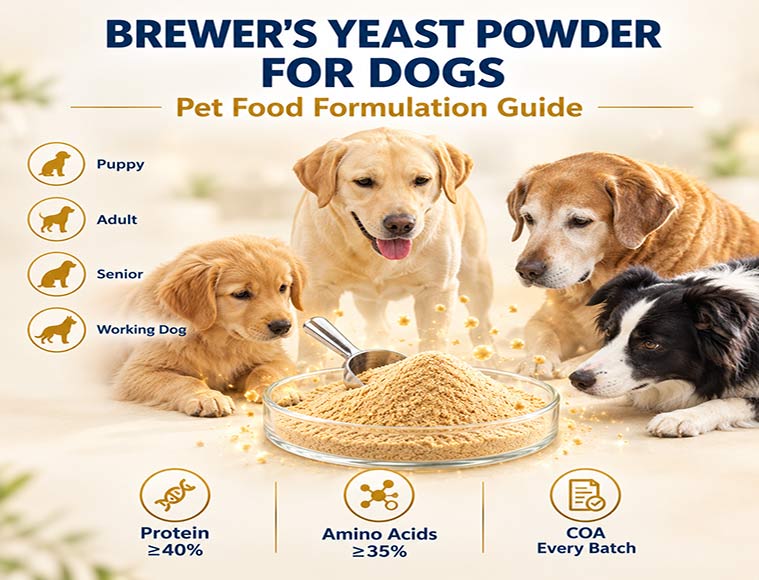
Specify brewer's yeast powder for dog food: compare crude pr...
Hotline+86 13821675082
Product Details
Pet food formulation has become a balancing exercise between three pressures that rarely point in the same direction: nutritional adequacy, palatability, and ingredient cost. A formulator can meet a nutrient profile on paper and still lose the product at the bowl, where a dog that refuses its food ends the conversation. A formulator can fix palatability and still miss a cost target. And an ingredient list that looks short and recognizable to a buyer must still be backed by a documented, repeatable supply chain.
Brewer's yeast powder keeps appearing in these conversations because it touches all three pressures at once. It is a concentrated source of protein and amino acids, a carrier of B-vitamins, a source of yeast cell wall components, and a flavor-active ingredient that formulators have long used in savory pet food systems. It is also a single-ingredient line item that can be specified, tested, and audited like any other raw material.
That same versatility is also the source of confusion. A buyer who asks for "brewer's yeast for dog food" may be asking for a protein ingredient, a palatant, a vitamin contributor, or a gut-support ingredient, and the right specification is different for each. This guide is written for pet food formulators, technical managers, and purchasing teams who need to turn the general idea of "adding brewer's yeast" into a specification, an inclusion plan, and a supplier evaluation that can be defended in a quality review.
The scope is deliberately practical. It covers what the ingredient is, what it contributes in a dog diet, how to think about inclusion by life stage without relying on a one-size-fits-all number, how processing format changes what the ingredient can and cannot do, how to design a pilot trial, which parameters belong on a purchase specification, and what to verify with a supplier before the first full-scale order. It does not make health claims about dogs, and it does not substitute for the formulator's own nutritional modeling and feeding trials.
Brewer's yeast is the yeast biomass recovered from beer fermentation. In feed and pet food applications it is collected, separated from the brewing stream, and processed into a dry powder. The processing route matters, because it decides what the finished powder contains and how consistent it is from one batch to the next.
Anqirui brewer's yeast powder is produced from active brewer's yeast cells and dried at low temperature. The stated purpose of low-temperature drying is to retain protein activity and amino acid structure rather than lose them to high-heat processing. The product specification is crude protein of 40% or more and amino acids of 35% or more, supplied in 25 kg bags, with each production batch tested for crude protein, amino acids, and moisture before shipment. The full species-by-species description of the product is covered in the brewer's yeast powder product application guide.
The compositional picture is straightforward. The powder is rich in protein and amino acids. It carries B-vitamins that yeast cells naturally contain. Its cell wall fraction contains mannan-oligosaccharides (MOS) and beta-glucans. Its cell contents include nucleic acids. None of these components is unique to yeast, but the combination in a single, standardized, dry ingredient is what makes the powder useful across many species and diet types.
One distinction needs to be stated clearly at the start, because it shapes the rest of this guide. A raw material that begins as live yeast does not automatically deliver live yeast to the animal. Whether cells are still viable at the moment of consumption depends on every thermal and mechanical step between the bag and the bowl. In pet food, the most demanding of those steps is extrusion, discussed in detail below. The general logic of separating what a yeast ingredient contains from what survives processing is covered in our guide to active versus inactive yeast in animal feed. For dog food, it leads to a practical rule: build the formulation case on composition, and treat any live-cell claim as something that must be separately verified in the finished product.
Describing what brewer's yeast powder "does" in a dog diet is easy to overstate. A more reliable approach is to describe the roles a formulator can ask it to play, and to attach to each role the evidence the formulator should collect.
The most direct role is nutritional. With crude protein of 40% or more and amino acids of 35% or more, the powder contributes protein density at a relatively small inclusion volume. Dog diets are formulated to meet minimum amino acid requirements, and a protein ingredient is only as useful as its amino acid profile and digestibility. The formulator's job is to look beyond the crude protein figure, ask for the amino acid profile, and check how the ingredient fits the amino acid balance of the whole recipe.
Yeast cells naturally contain B-vitamins involved in energy metabolism. In a complete and balanced dog food, vitamins are usually supplied through a premix at levels set to meet the nutrient profile, so the contribution of an ingredient such as brewer's yeast is one input among several. Where a formulator wants to count the ingredient's natural vitamin contribution, the supplier should provide analyzed values for the specific lots, because natural vitamin content varies with raw material and processing.
The yeast cell wall contains mannan-oligosaccharides and beta-glucans, components that have been studied across many animal species for their roles in gut ecology and immune signaling. For dogs, the honest position is that the response depends on the dose, the base diet, the study design, and the endpoint measured. A formulator who wants to build a gut-health or immune-support position around these components needs evidence that is specific to dogs and to the inclusion level actually used, and needs to follow the claim rules of the target market. The ingredient supplier can document the composition. The claim itself belongs to the finished product and must be substantiated at that level.
Yeast cell contents include nucleic acids and the nucleotides derived from them. They are discussed in animal nutrition mainly in connection with tissues that renew quickly, such as the gut lining, and with young animals. As with cell wall components, composition can be documented by the supplier, while any functional position for the finished dog food has to be supported at the product level.
Formulators commonly use yeast-derived ingredients in savory flavor systems for pet food. This role is the one most often cited for brewer's yeast in dog food, and it is also the one most dependent on the rest of the recipe. Palatability is a property of the whole product: the base ingredients, the fat level, the coating, the process, and the dog. The only reliable way to know whether brewer's yeast powder improves acceptance in a given formula is to test it, using intake and preference trials appropriate to the product type.
Application guides for livestock usually give a table of inclusion rates by stage. For pet food, that approach hides more than it reveals. Inclusion depends on the format, the base recipe, the target nutrient profile, the market's regulations, and the claims the brand intends to make. Anqirui's own product documentation takes the same position for all species: specific inclusion rates are set with a qualified nutritionist, based on species, growth stage, and the overall diet, and a small-batch trial comes before full-scale use. This guide follows that principle and offers a framework for deciding inclusion by life stage instead of a number that would not transfer from one recipe to another.
| Life stage | Typical formulation priority | Role to assign to brewer's yeast powder | What to verify before fixing inclusion |
|---|---|---|---|
| Puppy and growth | Nutrient density, digestibility, smooth transition to solid food | Protein and amino acid contribution; acceptance support during weaning transition | Amino acid balance of the complete recipe; digestibility; mineral balance; acceptance in the transition diet; compliance with growth nutrient profile |
| Adult maintenance | Consistent nutrition at controlled cost, stable acceptance | Cost-efficient protein and B-vitamin input; flavor-system component | Cost-in-use against alternatives; batch consistency; long-term acceptance, not only first-meal acceptance |
| Senior | Digestibility, protein quality, appetite support | Digestible protein source; acceptance support where appetite is a concern | Digestibility in the finished food; protein level against the senior formulation target; palatability in the intended format |
| Working and sport dogs | Energy supply, protein for recovery, reliable intake | Protein and amino acid input; natural B-vitamin contribution counted only against analyzed values | Total protein and amino acid delivery; intake stability; analyzed vitamin values by lot |
Growth diets are the most tightly constrained formulations in dog food. Requirements for protein, amino acids, and minerals are set with narrow margins, and errors have consequences that are slow to show and hard to reverse. In this setting, brewer's yeast powder is best treated as a nutrient contributor that must be modeled precisely, not as a general-purpose additive.
Two points deserve attention. First, yeast-derived ingredients contribute minerals as well as protein, and phosphorus in particular should be entered into the formulation model from analyzed values. In growth diets, calcium-to-phosphorus balance is closely controlled, especially for large-breed puppies, so any new ingredient needs a full mineral check rather than a protein-only assessment. Second, weaning-transition diets are often where acceptance matters most, because the puppy is learning to eat solid food. Acceptance trials should be run in the actual transition format, and the formulator should not extrapolate from adult trial results.
Adult maintenance is the largest volume segment and the one most sensitive to cost. Here the case for brewer's yeast powder rests on three questions. Does it deliver protein and amino acids at a lower cost per unit of usable nutrient than the alternatives it would partly replace? Does it support stable acceptance over weeks of feeding, not only on the first day? And can the supplier deliver the same specification lot after lot, so that the recipe does not drift?
The third question is the one most often neglected. A maintenance diet that is reformulated every time an ingredient lot varies will produce complaints that no single trial predicted. For maintenance diets, consistency is as valuable as any single nutritional property of the ingredient.
Senior formulations usually emphasize digestibility, protein quality, and sustained interest in food. Brewer's yeast powder can play a role as a digestible protein source and as a flavor-system component where appetite is a concern. Two cautions apply. Protein targets for senior diets are set by the formulator and the veterinary nutritionist for the intended population, so the ingredient should be added to meet a target rather than to raise protein for its own sake. And yeast nucleic acids contribute purines. For specialized diets aimed at dogs with a history of urate-related conditions, formulators and veterinary nutritionists typically review purine load as part of the design. This is a consideration for specialized diets, not a general concern for standard senior foods, but it belongs in the formulation review.
Diets for working and sport dogs are built around reliable intake, energy supply, and protein for recovery. Brewer's yeast powder can contribute protein and amino acids in a compact form, which helps in recipes where nutrient density is a constraint. B-vitamins are relevant to energy metabolism, but they should be counted only against analyzed values. Any performance-related claim requires evidence from studies on working dogs under comparable conditions, and the ingredient supplier cannot supply that evidence on behalf of the brand.
Define the role. Decide whether the ingredient is there to supply protein, contribute to the flavor system, add natural vitamins, or support a cell-wall-based position. One ingredient can have several roles, but each role has a different success test.
Model the nutrients. Put the analyzed crude protein, the amino acid profile, and the mineral values into the formulation software and check the effect on the whole recipe against the relevant nutrient profile for the life stage.
Set a trial range with the nutritionist. Choose a small number of inclusion levels to compare, based on the role and the recipe, not on a generic table.
Run acceptance and intake trials. Test the trial levels in the actual format, with the actual coating and process. Palatability measured on a lab mix does not predict palatability in finished kibble.
Verify the finished product. Analyze the finished food for the nutrients the ingredient was meant to contribute, rather than assuming the model matched the result.
Lock the specification. Once the level is chosen, write the ingredient specification, the incoming inspection plan, and the acceptable lot-to-lot range so the result can be repeated at production scale.
The format of the finished product decides what the ingredient can do, and the clearest example is the difference between extruded kibble and low-heat or post-process formats.
Extrusion combines heat, moisture, pressure, and mechanical shear. For a yeast ingredient, those conditions are decisive. The nutritional components, meaning protein and amino acids, remain part of the diet after extrusion, which is why the compositional case holds in kibble. Cell viability does not reliably survive extrusion, so a live-yeast claim should not be built on an ingredient that passes through the extruder. For extruded kibble, the sensible position is to specify brewer's yeast powder as a protein, amino acid, B-vitamin, and flavor-system ingredient, and to leave live-cell language out of the product concept.
Inside the extrusion line, the practical questions are about how the powder behaves. A fine powder blended into the dry mix must disperse evenly, flow through feeders without bridging, and avoid segregating from coarser ingredients during conveying. Moisture in the powder affects flow and, through the dry mix, can affect conditioning. Formulators should confirm the effect of the powder on the dry mix's flow and on the pellet or kibble's expansion and density during the first plant trial, since a change in one ingredient can shift process settings that were tuned for another recipe. Any such adjustments belong in the written process record so the trial can be reproduced.
Many pet foods receive a fat and palatant coating after extrusion. Adding the powder at the coating stage avoids the full extrusion exposure and is a common route for flavor-active ingredients. It also changes the testing question. The relevant questions become how evenly the powder adheres, how the coating performs through storage and transport, and how acceptance changes at the chosen level.
Several practical points apply. Dry powders in a fat coating can form clumps or settle in the coating tank, so mixing and circulation need to be checked. Coating adhesion depends on kibble temperature, surface condition, and fat level, and a powder that adheres well in one line can shed in another. Shedding shows up as dust in the bag, which consumers notice. The formulator should therefore inspect finished bags after transport simulation, not only freshly coated product. If any viability-related claim is part of the concept, the live count has to be measured in the finished product after coating and storage, because a raw material count does not describe the finished food.
Thermal exposure varies widely across these formats. A high-temperature bake behaves like extrusion for the purposes of viability. A cold-processed or low-heat format leaves more room for retained cell activity, but retained activity must be demonstrated by analysis, not inferred from the product description. For all treat formats, particle size, flow, and moisture matter as much as composition, since a powder that clumps or segregates creates lot-to-lot differences in the finished product.
Soft and semi-moist formats add a further consideration: water activity. An ingredient that attracts moisture can shift water activity in the finished treat, which affects shelf life and microbial stability. The formulator should include the powder in water activity and shelf-life testing of the finished product, rather than relying on data for the base recipe without it.
In canned or pouched products, thermal sterilization applies to the whole product, so cell viability is not a relevant claim. The ingredient's value is compositional, and the formulation questions are about how yeast protein and cell wall components behave in a wet matrix: viscosity, texture, and flavor contribution. Small-scale cooking trials are the practical way to find out.
For supplement formats that are not heat-processed, the ingredient's low-temperature manufacturing becomes more relevant, but the labeling and claim rules for supplements differ from those for complete and balanced foods and vary by market. The formulation and the claims should be reviewed against the rules of the destination market before launch.
Dry yeast powder is sensitive to moisture. Store it in a cool, dry, well-ventilated place away from direct sunlight, keep bags sealed between uses, and follow the shelf-life information on the packaging and in the test report. Moisture uptake can cause caking and quality loss, and these are far cheaper to prevent than to diagnose after a production problem. Fine organic powders also generate dust during bag dumping and conveying, so dust control and housekeeping should follow the plant's own safety procedures for combustible dusts and for worker exposure.
A pilot trial turns an ingredient decision into evidence. The design should match the question the formulator is actually asking, because different questions need different trials.
Which version do dogs prefer? A two-bowl preference test, where dogs choose between a control and a test food presented side by side, answers this. It measures preference, not total intake.
Will dogs eat the food reliably over time? A single-bowl intake trial over a period of days or weeks answers this. It measures how much of a food the dogs eat when it is the only option.
Does the food meet nutritional adequacy? That is a formal feeding trial or a formulation-based demonstration against the relevant standard, and it is a finished product matter, not an ingredient trial.
A defined control. The control is the same recipe without the ingredient, or with the ingredient it would replace, produced in the same run so that the only difference is the variable under test.
Presentation controls. Rotate bowl positions in preference tests, standardize feeding times and amounts, and keep handlers unaware of which food is which where possible.
An appropriate panel. The number of dogs and the trial length should be set with a statistician or an experienced trial provider, based on the effect size the formulator wants to detect.
Representative dogs. The panel should reflect the life stage and size range the product is intended for. Adult trial results do not describe puppy acceptance.
Documented lots. Record the ingredient lot, the batch records, and the certificate of analysis for every food tested, so the result can be tied to a specific material.
Trials commonly record intake and preference, and many also record observations such as stool quality scores and body condition, collected by trained evaluators using standard scoring scales. These endpoints describe how the dogs responded to a particular finished food over a particular period. They are useful for development and for catching problems early, but they should not be turned into claims about the ingredient itself unless the study was designed and powered for that purpose.
A positive preference result at one inclusion level does not show that a higher level would perform better, and a neutral result does not show that the ingredient has no role. Results should be read against cost: an inclusion level that improves acceptance only marginally may not justify its cost, while a level that stabilizes intake in a difficult recipe may justify a higher cost. Every conclusion should be recorded with the trial design, so that later reformulations can be compared on the same basis.
A pet food purchase specification for brewer's yeast powder should go well beyond a protein percentage. The following parameters make the specification verifiable.
Crude protein, with the test method stated. The reported figure should be traceable to a named analytical method. The reasons crude protein alone is an incomplete basis for comparison are covered in our guide to crude protein and functional parameters in brewer's yeast powder.
Amino acid profile. Request the analyzed profile, not just a total, so the formulator can check essential amino acid balance in the recipe.
Moisture and ash. Moisture affects storage stability and the effective nutrient content per kilogram. Unexpectedly high ash can point to processing residues or dilution.
Mineral values. Request analyzed values for the minerals the formulation depends on, particularly phosphorus, so growth and senior diets can be modeled accurately.
Particle size and flowability. These determine mixing behavior, coating adhesion, and segregation risk.
Cell wall components. If MOS or beta-glucan content is part of the product concept, the supplier should state the values together with the assay method, since different methods can report different numbers for the same parameter.
B-vitamin values. Only count the ingredient's natural vitamin contribution if analyzed values by lot are provided.
Contaminants. Heavy metals, mycotoxins, and microbial load belong on the standard certificate of analysis. Pathogen control, and Salmonella in particular, is a serious compliance matter for pet food in major markets, so the specification should state the required microbial limits and the testing frequency.
Raw material origin and residue control. Because brewer's yeast originates in brewing, ask how the supplier controls the raw material stream, including removal of non-yeast residues from the brewing process. This matters for ingredient-statement accuracy and for claims such as grain-free positioning.
Certificate of analysis with every batch. The certificate should reflect the parameters above and be supplied automatically, not only on request.
Packaging and traceability. Standard packaging is 25 kg sealed bags. Lot coding should allow a finished product lot to be traced back to the ingredient lot.
Regulatory requirements for pet food are set by the destination market, and the same recipe can face different rules in different countries. The points below are the checks that should happen before a formula is finalized, not a substitute for regulatory advice.
Ingredient naming. Confirm the ingredient name that is acceptable on the label in the target market, using the current ingredient definitions that regulators or feed control officials recognize there. In the United States this means checking the current AAFCO ingredient definitions and the rules of the relevant state or authority. In the European Union it means checking the feed materials framework and the labeling rules for pet food.
Nutritional adequacy. Complete and balanced claims are made at the finished product level against recognized nutrient profiles or feeding trial protocols, such as those published by AAFCO and, in Europe, by FEDIAF. An ingredient cannot make a product complete and balanced. It can only contribute to the formulation.
Claims. Statements about gut health, immunity, or other functional benefits are governed by market-specific claim rules. A claim should match the evidence available for the finished product and the dog population it addresses.
Import and documentation requirements. Export markets often require specific documents, registrations, or health certificates for ingredients of this type. Check them early, since missing paperwork delays shipments and increases inventory cost.
Batch consistency. Regulatory compliance in practice depends on repeatability. The logic of why batch-to-batch variation threatens compliance is explained in our guide to batch stability and AAFCO compliance for brewer's yeast, and it applies to pet food as much as to livestock feed.
Treating brewer's yeast powder only as a palatant. It is also a protein and amino acid ingredient, and ignoring that role means ignoring its largest nutritional contribution and its effect on the recipe's cost.
Assuming live cells reach the dog in extruded food. Extrusion conditions do not reliably preserve cell viability. Live-yeast language belongs only where a finished-product viable count supports it.
Reading crude protein as usable protein. Crude protein is a laboratory figure. Amino acid profile and digestibility decide what the dog can actually use.
Skipping the mineral check in growth diets. A protein-only assessment misses the effect of the ingredient on the calcium and phosphorus balance of the whole recipe.
Using one inclusion level for every life stage. Puppy, adult, senior, and working diets have different priorities, and the inclusion plan should reflect the role the ingredient plays in each.
Testing palatability on a lab mix. Acceptance in a finished, coated kibble can differ from acceptance in a bench mix. Test in the real format.
Repeating consumer myths in product claims. Claims such as flea or tick repellency circulate widely in consumer discussion but are not supported by reliable evidence, and they do not belong in a manufacturer's claim set.
Comparing suppliers on price per kilogram. The relevant cost is cost per unit of verified nutrient or function delivered, discussed in the next section.
Accepting a certificate of analysis without method information. A number without a method cannot be compared across suppliers or across time.
Skipping lot-level verification after the trial. A trial result belongs to the lot that was tested. Production specifications must define how future lots are checked against it.
Comparing two brewer's yeast powders on price per kilogram assumes that a kilogram of each delivers the same thing. It does not. Cost-in-use asks a different question: what does it cost to deliver a unit of the thing the formulation actually needs?
For the protein role, the working relationship is simple. Cost per unit of delivered protein equals the price per kilogram divided by the product of the protein fraction and its digestibility. A cheaper powder with lower protein density, or with lower amino acid quality, can cost more per unit of usable protein than a higher-priced powder with better specifications. The same reasoning applies to amino acids, where the limiting amino acid in the recipe is usually the one that matters.
For the flavor-system role, cost-in-use is measured through acceptance. If a trial shows that a modest inclusion improves intake stability in the finished food, the value is the avoided cost of reformulation, returns, or reduced repeat purchase, not the ingredient's price. Because that value depends entirely on the trial result, it is another reason to run acceptance testing in the real format.
Other items belong in the same calculation: freight and packaging, minimum order quantities, storage losses from moisture, the labor of handling an ingredient that segregates or clumps, and the cost of incoming testing. A supplier who provides complete certificates of analysis and consistent lots lowers these hidden costs, and that benefit does not appear on the price list.
Moving from the first sample to a stable production supply is a sequence of gates. Each gate has a clear pass condition, and skipping one tends to surface later as a more expensive problem.
Sample evaluation. Request a sample with its certificate of analysis. Run the formulator's own laboratory checks on protein, moisture, and the other key parameters, and compare them with the certificate. Differences between the supplier's figures and independent figures should be understood before going further.
Bench trials. Test the powder in the formulation at small scale to see how it blends, flows, and affects the dry mix. Record observations on dust, clumping, and color.
Pilot production. Make the product on pilot equipment in the chosen format, using the process settings the plant will use. Record the process conditions, because they are part of what the trial result depends on.
Acceptance and intake trials. Run the trial design from the section above on the pilot product.
Finished product analysis. Analyze the pilot product for the nutrients and parameters that matter to the formulation and the label.
Regulatory and label review. Confirm ingredient naming, claim wording, and documentation for each target market before committing to a launch date.
First production lots. Place a production-scale trial order, ideally covering more than one lot, to check consistency across lots at commercial volume.
Incoming quality control. Define the incoming inspection plan: which certificate values are verified, which are tested by the plant, and how often.
Ongoing monitoring. Keep a record of lot results over time so drift can be detected early, and review supplier performance on a fixed schedule.
Suitability is a formulation question, not a general assurance. It depends on the life stage, the rest of the recipe, the format, the claims the brand intends to make, and the market's rules. Dogs can show sensitivities to individual ingredients, so limited-ingredient or specialized diets deserve a careful review of the ingredient list and any related claims. A nutritionist's review of the finished formula is the right check.
Not reliably in extruded or baked products, because the process conditions do not preserve cell viability. In low-heat or post-process formats, any retained activity has to be demonstrated by analysis of the finished product after storage. A viable count on the raw material does not describe the finished food.
It is better suited as a partial contributor than as a full replacement. Dog diets are built on amino acid balance, digestibility, and palatability across the whole recipe, so the ingredient's share depends on what the formulation needs. A nutritionist can model the partial substitution and the trial can confirm how dogs respond.
A certificate of analysis for the lot with the test methods named, the amino acid profile, contaminant and microbial results, lot coding that supports traceability, and any export or import documents the destination market requires. Having these in hand before the first production run avoids delays.
Through the six-step method in this guide: define the role, model the nutrients, set a trial range with a nutritionist, test acceptance in the real format, verify the finished product, and lock the specification. The result is an inclusion level that belongs to the specific recipe, which is more reliable than a rate borrowed from a different one.
A certificate of analysis is supplied with every batch, with the test method named for each parameter.
The amino acid profile and mineral values are available, not only the total protein figure.
Batch-to-batch consistency data can be provided on request.
Contaminant and microbial testing results are available, with limits suited to pet food use.
The supplier can describe raw material origin and the controls on non-yeast residues.
Particle size and flow characteristics are documented.
Lot coding supports traceability from finished product back to the ingredient lot.
The supplier supports production-scale trial orders, not only small samples.
Technical documentation is available to support the buyer's own regulatory and quality files.
Brewer's yeast powder earns its place in dog food by doing specific, measurable jobs: supplying protein and amino acids at a given density, contributing natural B-vitamins, adding yeast cell wall components, and supporting the flavor system of the recipe. The jobs are the same across life stages, but their weight changes, which is why the inclusion plan should be built around the role the ingredient plays in each diet rather than around a single number. The processing format decides what the ingredient can claim. In extruded kibble, the case rests on composition. In low-heat formats, any live-cell position must be proven in the finished product.
The practical sequence is consistent: define the role, model the nutrients, set a trial range with a nutritionist, test acceptance in the real format, verify the finished product, and lock a specification that future lots must meet.
Anqirui supplies brewer's yeast powder for feed and pet food manufacturers. Technical documents, batch certificates of analysis, and trial-order specifications are available on request.