
Focus on Feed Additions Global Supply
-13 Years in the Feed Additives Market.
Hotline+86 13821675082
Focus on Feed Additions Global Supply
-13 Years in the Feed Additives Market.

 Hotline +86 13821675082
Tel:+8613661236356
Email:sales@yeastpowderco.com
Add:Rm603 Central building, Xinmao Huayuan Park, Xiqing Dist., Tianjin China-300392
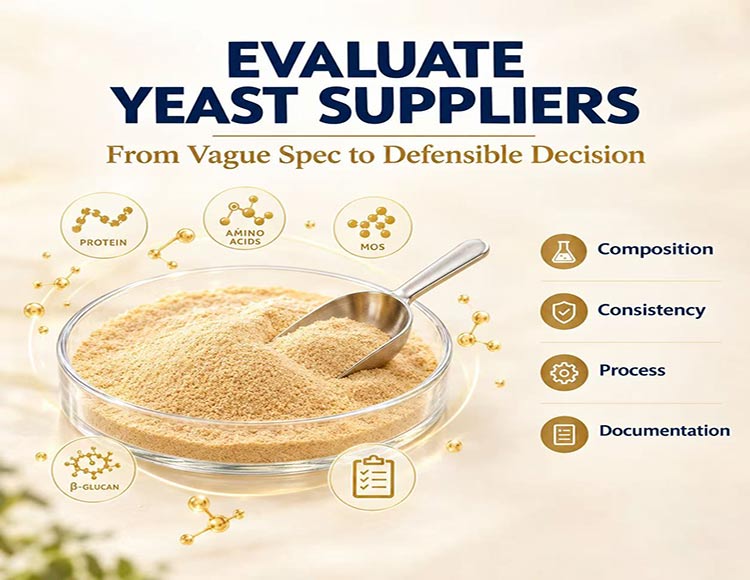
Practical checklist to evaluate yeast protein and prebiotic yeas...
Hotline+86 13821675082
Product Details
Pull the raw material specification sheets for ten different feed formulations and look for the word "yeast." It will appear on nearly every one of them — usually as a single line item with a single inclusion rate. What that line item actually contains, however, varies enormously depending on which supplier and which product filled it in. Some formulations call for a live microbial culture; others call for a product that was never meant to arrive alive. The two are not interchangeable, and the supplier you choose determines whether the ingredient delivers the function your formulation depends on.
This guide walks through the evaluation framework that feed mills, pet food manufacturers, and premix companies should use when sourcing yeast protein and prebiotic yeast ingredients — from raw material origin and processing method to specification parameters, batch consistency, and cost-in-use.
Before comparing suppliers, define the functional category. "Yeast" on a label covers at least five commercially distinct products:
Brewer's yeast powder — inactivated whole-cell yeast, valued for crude protein (typically 40–50%), nucleotides, and B-vitamins. Functions simultaneously as a partial protein source and a functional additive.
Yeast hydrolysate — whole cells subjected to autolysis or enzymatic hydrolysis, releasing small peptides, free amino acids, and nucleotides. Used in premium starter diets and pet food as a palatant and gut-support ingredient.
Yeast cell wall — the insoluble fraction after cell contents are removed, concentrated in beta-glucan and mannan-oligosaccharides (MOS). The primary prebiotic yeast category.
Yeast extract — the soluble cytoplasmic fraction, high in free amino acids and flavor nucleotides. Used primarily for palatability in pet food and aquafeed.
Active dry yeast — live Saccharomyces cerevisiae cells dried under controlled low-temperature conditions. Functions through viable-cell mechanisms (competitive exclusion, oxygen scavenging), not through composition.
The first four are inactivated products. Their value rests on chemical and structural composition — protein, beta-glucan, MOS, nucleotides. Active dry yeast is a different category entirely: its value rests on cell viability surviving drying, storage, and pelleting conditions. A supplier that excels at one category may not excel at another. Evaluate each category separately.
Yeast biomass enters the feed supply chain from two sources:
Spent yeast from beer breweries or fuel ethanol plants is harvested, washed, and dried. It is typically lower cost but more variable in composition — protein content, bitterness compounds, and residual carbohydrate can shift between batches depending on the brewery's recipe and fermentation schedule. Byproduct yeast is common in brewer's yeast powder and can be perfectly functional, but batch-to-batch consistency is the key question to ask the supplier.
Yeast cultivated specifically for feed or pet food use on a defined molasses or glucose medium. More consistent in composition, lower in bitter compounds, and generally higher in beta-glucan and MOS per unit of cell wall. Purpose-grown biomass is the standard for yeast cell wall, hydrolysate, and extract products where functional polysaccharide content is the primary specification.
Evaluation question: Does the supplier disclose the raw material origin for each product? Can they provide composition data showing batch-to-batch variability over the last 12 months?
The same yeast biomass processed three different ways yields three functionally different products.
The standard method for brewer's yeast powder. The yeast slurry is applied to a heated rotating drum and scraped off as a dry flake. Temperature is high but contact time is short. Protein and nucleotides are largely preserved; beta-glucan structure can be partially degraded if drum temperature is not controlled.
Used for yeast extract, hydrolysate, and some cell wall products. The liquid feed is atomized into a hot air chamber. Lower particle temperature than drum drying due to evaporative cooling, but the process requires the material to be soluble or finely suspended. Spray-dried products typically have better-preserved beta-glucan and MOS structure.
For hydrolysate and extract, cells are intentionally ruptured by controlled heat (autolysis) or by added enzymes (proteases, nucleases, glucanases). The degree and specificity of hydrolysis determine the peptide profile, free amino acid content, and nucleotide yield. A poorly controlled hydrolysis can over-degrade the cell wall polysaccharides that give the product its prebiotic value.
Evaluation question: What drying or hydrolysis method does the supplier use for each product? Do they have process control data (temperature, residence time, enzyme dosage) that they can share?
A specification that only states an inclusion rate and a product category is incomplete. The following parameters distinguish a specification a supplier can be held accountable to from one that cannot be independently verified.
| Parameter | Why It Matters | Typical Range |
|---|---|---|
| Crude protein | Nutritional value; but does not measure function | 40–60% depending on product |
| Beta-glucan | Immune-modulating polysaccharide; the primary prebiotic fraction | ≥20% in cell wall; 10–15% in whole cell |
| MOS (mannan-oligosaccharides) | Pathogen-binding fraction; decoy for type-1 fimbriated bacteria | ≥20% in cell wall; 8–12% in whole cell |
| Small peptide content | Hydrolysate-specific; directly absorbable, supports gut epithelium | 30–40% in premium hydrolysate |
| Nucleotide content | Supports rapid cell turnover in young or stressed animals | 5–12% depending on hydrolysis |
| Moisture | Affects storage stability and effective potency per kg | ≤6–10% |
| Ash | Elevated ash can indicate processing residues or adulteration | ≤5–8% |
Critically, beta-glucan and MOS values are only comparable when the assay method is disclosed. Different analytical methods (e.g., Megazyme beta-glucan assay vs. acid hydrolysis + HPLC) can yield materially different reported values for what is nominally the same compositional parameter. A supplier that will not disclose the assay method is making cross-supplier comparison impossible by design.
| Parameter | Why It Matters |
|---|---|
| Viable cell count (CFU/g) at shipment | Nominal potency |
| Guaranteed CFU/g at end of shelf life | Worst-case delivered dose; the figure that should be used for formulation |
| Strain identification | Thermal tolerance and functional characteristics are strain-specific, not species-wide |
| Moisture | Drives storage stability |
| Post-pelleting viable count | Measured in finished feed at the buyer's actual pelleting temperature and retention time — not in the supplier's lab under favorable conditions |
The single most common point of disappointment in the field is active dry yeast that shows an excellent pre-mix CFU count but delivers a functionally depleted count in the finished pellet. Always request post-pelleting data generated under your mill's conditions.
A supplier can send an excellent sample and still ship inconsistent production batches. Request:
Certificate of Analysis (COA) with every shipment — not only when specifically requested. The COA should include all specification parameters, the assay methods used, and the lot number.
Batch-to-batch variability data — ask for the last 6–12 months of COA data for the product you intend to buy. Calculate the coefficient of variation (CV) for key parameters (crude protein, beta-glucan, moisture). A CV above 5–8% on a functional parameter indicates inconsistent process control.
Retained sample policy — does the supplier retain a sample from each batch for a defined period, and can they provide it for independent third-party testing if a dispute arises?
Feed-grade yeast products entering international trade are subject to import-country feed safety regulations that specify maximum contaminant thresholds. Because some raw material streams originate from brewing byproducts, microbial load and mycotoxin carryover are real concerns.
A credible supplier includes the following as standard on every COA, not as an optional add-on:
Heavy metals (lead, arsenic, cadmium, mercury)
Mycotoxins (aflatoxin, zearalenone, deoxynivalenol, ochratoxin)
Microbial load (total plate count, Salmonella, E. coli, yeast/mold count)
Pesticide residues (where relevant to the growth medium)
For pet food applications, additional testing for dioxins, PCBs, and processing contaminants (e.g., acrylamide, furan) may be required depending on the target market's regulatory framework.
Certifications are not a guarantee of product quality, but they are a baseline indicator that the supplier operates a documented quality system. Relevant certifications include:
ISO 9001 — general quality management
HACCP — hazard analysis critical control point, standard for feed and food
GMP — good manufacturing practice for feed additives
FAMI-QS — the European feed additive and premixture quality system, particularly relevant if supplying EU customers
ISO 22000 — food safety management, relevant for pet food grade ingredients
Organic certification — if the product is intended for organic feed or pet food lines
Verify that certifications are current, cover the specific product and production site you are sourcing from, and are issued by an accredited third-party body — not self-declared.
A supplier with an excellent product but insufficient capacity becomes a liability when your order volume grows or when the market tightens. Evaluate:
Nameplate capacity for each product, and current utilization rate. A supplier running at 95%+ capacity has limited room to absorb your volume growth.
Number of production sites. Single-site suppliers carry concentration risk — a fire, flood, or regulatory shutdown can halt supply entirely.
Lead times for standard and custom orders, and whether they are consistent across seasons.
Inventory policy. Does the supplier hold finished-goods safety stock, or is every order produced to order?
Export experience. A supplier that has never exported to your target market may struggle with documentation, packaging requirements, and regulatory compliance at destination.
Yeast ingredients are rarely plug-and-play. Formulation questions — optimal inclusion rate by species and production stage, compatibility with other feed additives, pelleting tolerance, interaction with mycotoxin binders — require technical support that goes beyond a sales conversation.
Evaluate whether the supplier can:
Provide species-specific application guidance with cited data, not generic recommendations
Support trial design and interpretation at your facility or with a partner institution
Customize particle size, packaging (25 kg bags, bulk, tote), and labeling (neutral, customer-branded)
Offer technical literature, COA templates, and regulatory documentation for import clearance
Respond to technical inquiries within a defined timeframe, in your working language
For pet food applications, additional capabilities matter: palatability testing support, label-claim substantiation, and compliance with AAFCO or FEDIAF nutrient profiles depending on the target market.
Comparing yeast products purely on per-kilogram purchase price is a formulation-level error. The relevant metric is cost per unit of verified function delivered to the animal.
For inactivated products, this means calculating cost per kg of beta-glucan or MOS delivered — not cost per kg of powder. Two products priced identically per kilogram can differ two-fold in beta-glucan concentration, meaning the effective cost per unit of prebiotic function diverges even when the sticker price is identical.
For active dry yeast, this means factoring expected viability loss during pelleting and storage into the effective dose. A lower-priced product with weak pelleting survival can require double the inclusion rate to achieve the same viable count at feed-out — at which point it is no longer cheaper.
Neither comparison is possible without the specification parameters described in Section 4. Cost-in-use analysis is only as good as the data a supplier is willing to disclose and stand behind with a COA.
Never move from sample to full-scale purchase without a production-scale trial. A small lab sample may not reflect batch-to-batch consistency at commercial volume.
A structured trial sequence:
Laboratory evaluation — verify the supplier's COA against independent third-party testing for key parameters (protein, beta-glucan, MOS, moisture, contaminants).
Palatability and acceptability trial — particularly for pet food and young animal diets, where yeast ingredients can influence feed intake.
Production-scale trial batch — at least one full production run at your facility, with post-processing analysis (for active yeast: post-pelleting CFU; for inactivated: beta-glucan recovery).
Animal performance trial — where feasible, a controlled feeding trial measuring the endpoint the ingredient is meant to improve (growth rate, feed conversion, diarrhea incidence, egg production, immune markers).
Second-batch confirmation — repeat the COA verification on a second production batch to confirm consistency.
Only after all five steps should a supplier be moved to approved-vendor status for ongoing volume.
Confusing crude protein with functional quality. Two inactivated yeast products at identical protein percentage can differ substantially in beta-glucan or MOS concentration.
Accepting "yeast" as a specification. A purchase order that reads "yeast, per formulation" gives the supplier no information about which functional category is required — and no basis for rejecting a shipment that is technically compliant but functionally wrong.
Assuming all cell wall products are equivalent. Beta-glucan and MOS content and structural integrity depend heavily on extraction method, strain, and growth conditions.
Buying active yeast on pre-mix CFU alone. The number that matters is post-pelleting, at your mill's conditions, at end of shelf life.
Overlooking pet food regulatory requirements. Ingredients acceptable for livestock feed may not meet the stricter contaminant and labeling thresholds for pet food in the EU, US, or other regulated markets.
Ignoring language and time-zone barriers. A supplier that cannot communicate technical details in your working language within your business hours will slow down every issue that arises.
Use the following weighted scorecard to compare suppliers objectively. Adjust weights based on your priorities (e.g., pet food manufacturers may weight contaminant testing and certification more heavily; commodity feed mills may weight capacity and price more heavily).
| Evaluation Criterion | Weight | What to Score |
|---|---|---|
| Specification completeness and transparency | 15% | All parameters disclosed with assay methods; COA automatic with every shipment |
| Batch consistency (12-month CV data) | 15% | CV <5% on key parameters = excellent; 5–8% = acceptable; >8% = concern |
| Functional parameter concentration (beta-glucan / MOS / peptide) | 15% | Cost per unit of function, not per kg of powder |
| Contaminant testing program | 10% | Full panel standard on COA; third-party verified |
| Certifications (FAMI-QS, HACCP, GMP, ISO) | 10% | Current, third-party, covering the specific product/site |
| Production capacity and supply security | 10% | Multi-site, utilization <85%, consistent lead times |
| Technical support and customization | 10% | Species-specific data, trial support, custom packaging |
| Cost-in-use competitiveness | 10% | Calculated on delivered function, not sticker price |
| Export and regulatory experience | 5% | Track record to your target market; documentation support |
Yeast protein and prebiotic yeast are not commodity ingredients where the lowest price wins. They are functionally specific ingredients whose value depends on raw material origin, processing control, compositional integrity, and batch-to-batch consistency — all of which vary more between suppliers than the shared label word "yeast" suggests.
The right evaluation process is: define the functional category, specify the parameters that matter, demand assay-method transparency, verify consistency over multiple batches, calculate cost-in-use rather than per-kilogram price, and validate with a production-scale trial before committing to volume. A supplier that will not support this process with data, documentation, and accessible technical support is not a supplier you should bet your formulation on.
Anqirui supplies both inactivated yeast products (brewer's yeast powder, yeast hydrolysate, yeast cell wall, yeast extract) and active dry yeast for feed mills and pet food manufacturers. Batch COAs with full contaminant panels, 12-month consistency data, and production-scale trial orders are available on request. For species-specific application guidance, see our swine feed yeast application guide and specialty species applications.