
Focus on Feed Additions Global Supply
-13 Years in the Feed Additives Market.
Hotline+86 13821675082
Focus on Feed Additions Global Supply
-13 Years in the Feed Additives Market.

 Hotline +86 13821675082
Tel:+8613661236356
Email:sales@yeastpowderco.com
Add:Rm603 Central building, Xinmao Huayuan Park, Xiqing Dist., Tianjin China-300392
Live vs inactivated yeast for feed: compare CFU, beta-glucan, pe...
Hotline+86 13821675082
Product Details
Pull the raw material specification sheets for ten different feed formulations and look for the word "yeast." It will appear on nearly every one of them, usually as a single line item with a single inclusion rate. What that line item actually contains, however, varies enormously depending on which supplier and which product filled it in. Some formulations are calling for a live microbial culture — cells that must survive drying, storage, transport, and the mechanical and thermal stress of pelleting, and that only deliver value if a measurable fraction of them are still alive when the animal eats the feed. Others are calling for a product that was never meant to arrive alive. It was deliberately inactivated during processing, and its entire value proposition rests on the composition of what is left behind — the protein, the cell wall polysaccharides, the nucleotides — rather than on any surviving biological activity.
These are not two grades of the same commodity sitting at different price points. They are two functionally distinct additive categories that happen to share a common raw material — yeast biomass — and a common label word. A feed mill that treats them as interchangeable, substituting one for the other when a supplier is out of stock or offering a better price, is not making a like-for-like swap. It is changing the mechanism of action the formulation depends on, often without realizing it.
This confusion has a concrete cost at the point of specification. A purchase order that reads "yeast, per formulation" or lists only a crude protein percentage gives a supplier no information about which functional category is actually required. The supplier can legally and technically fulfill that order with either type, because nothing in the specification excluded one or the other. The buyer only discovers the mismatch later — when the expected functional outcome doesn't materialize, and the root cause is invisible because the ingredient name on the invoice never changed.
The purpose of this guide is to make that distinction explicit and specifiable: what separates active from inactive yeast, why the two work through different biological mechanisms, how each behaves under real feed mill processing conditions, and what a buyer should actually be asking for when writing a specification — regardless of which supplier fills it.
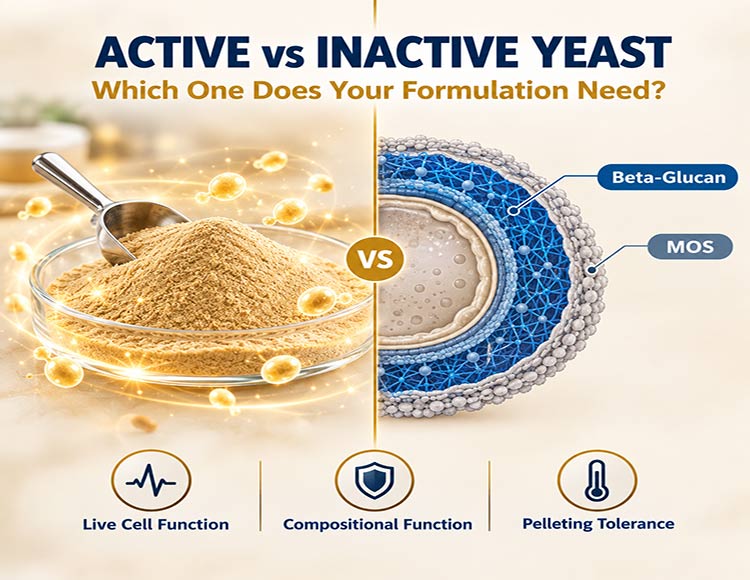
Active dry yeast, in the context of animal feed, refers to a specific single-celled fungal organism — typically a selected strain of Saccharomyces cerevisiae — that has been fermented, harvested, and then dried under controlled, relatively low-temperature conditions designed to preserve cell viability rather than destroy it. The drying step is the critical differentiator: it is engineered to bring moisture content down to a level that allows for stable storage, while keeping the internal cellular machinery of a defined percentage of cells intact enough that they can rehydrate and resume metabolic activity once they reach a moist environment — namely, the gastrointestinal tract of the animal. The product is functional specifically because it is alive, or more precisely, because a guaranteed proportion of its cells remain viable and capable of germination at the point of consumption.
Inactive, or inactivated, yeast is a broader category that includes several commercially distinct products, most commonly supplied to the feed industry as brewer's yeast powder, yeast cell wall extract, or yeast hydrolysate. These products originate from yeast biomass — sometimes a byproduct of brewing or ethanol fermentation, sometimes purpose-grown — that is deliberately subjected to heat treatment, autolysis, or other processing steps that eliminate cell viability. Once inactivated, the cell wall and cell contents can be further processed: the wall can be separated and concentrated to isolate its beta-glucan and mannan-oligosaccharide (MOS) fractions, or the whole cell can be hydrolyzed to release nucleotides, peptides, and free amino acids from the cytoplasm. The resulting product is valued entirely for its chemical and structural composition — crude protein content, beta-glucan concentration, MOS concentration, nucleotide content — because there is no viable cell activity left to contribute anything else. A more detailed breakdown of how these compositional categories differ from one another is covered in our yeast ingredient category overview.
It is worth being precise about a point that gets blurred in casual industry conversation: "inactive" does not mean "lower quality" or "less processed." In many cases, inactivation and downstream extraction is a more technically demanding process than simply drying live cells, because it requires controlling the heat or enzymatic treatment precisely enough to preserve the beta-glucan and MOS structures on the cell wall rather than degrading them. A poorly controlled inactivation process can destroy the very components that give the inactivated product its functional value, just as a poorly controlled drying process can kill more live cells than intended in an active yeast product. Both categories require process control; they are simply controlling for different endpoints.
Neither category is a downgrade or an upgrade of the other. They are manufactured to answer two different formulation questions, and understanding which question a given formulation is trying to answer is the first step to specifying the right product.
The functional separation between active and inactive yeast becomes clearest when the underlying mechanisms of action are laid out side by side, because they do not overlap and they do not depend on the same conditions to work.
Live yeast cells act primarily through mechanisms that require biological activity. Competitive exclusion is one of the most cited: live cells occupy physical attachment sites along the gut lining and compete with pathogenic organisms for the same limited real estate, making it physically harder for pathogens to establish a foothold. A second mechanism is oxygen scavenging — actively metabolizing cells consume residual oxygen in the gut lumen, particularly relevant in the neonatal or post-weaning gut where oxygen levels can otherwise favor the growth of facultative anaerobic pathogens over the beneficial obligate anaerobes that dominate a healthy mature gut microbiome. A third, more indirect mechanism involves the production of metabolites and enzymes during active fermentation in the gut environment, which can influence local pH and nutrient availability for the surrounding microbial community. Every one of these mechanisms shares a single non-negotiable precondition: the cells have to still be alive and metabolically capable when they reach the site of action. A dead cell cannot compete for an attachment site, cannot consume oxygen, and cannot ferment.
Inactivated yeast components work through an entirely different, viability-independent pathway. Beta-glucan, a polysaccharide embedded in the yeast cell wall, is recognized by pattern recognition receptors on immune cells — most notably Dectin-1 receptors on macrophages and dendritic cells — triggering a cascade of innate immune activation that primes the animal's immune system to respond more effectively to subsequent pathogen exposure. This interaction happens whether the cell that the beta-glucan came from is alive or dead; what matters is the molecular structure of the polysaccharide itself, not any ongoing metabolic process. Mannan-oligosaccharide, also derived from the cell wall's outer mannoprotein layer, works through a different but complementary mechanism: many pathogenic bacteria, including certain strains of Salmonella and E. coli, use type-1 fimbriae — hair-like surface appendages — to attach to mannose residues on the gut epithelium as the first step in colonization. MOS presents a decoy: free mannose structures that the pathogen's fimbriae bind to instead of the actual gut wall, effectively flushing the pathogen out of the digestive tract before it can establish an infection. Separately, the crude protein, peptides, and nucleotides released during hydrolysis or contained within brewer's yeast powder contribute nutritionally, supporting protein synthesis and, in the case of nucleotides, potentially supporting rapid cell turnover in tissues like the gut epithelium and the developing immune system — particularly relevant in young or newly weaned animals with high nucleotide demand and limited de novo synthesis capacity.
Because these two sets of mechanisms are mechanistically independent rather than redundant, a number of feed programs deploy both categories simultaneously rather than treating the choice as either/or — using active dry yeast for microbial competition during a defined stress window, alongside a cell wall or hydrolysate product for baseline immune priming and pathogen binding. This combined-mechanism approach is discussed in the context of a specific stress period in our swine feed application guide, which addresses the post-weaning window in more detail.
Without going into specific inclusion rates — which vary by species, production stage, and formulation, and are covered in the species-specific application guides referenced throughout this article — it is useful to understand the general logic that determines which category tends to be specified for which production context.
Live active dry yeast is most frequently specified in situations where gut microbial balance is under acute, time-limited pressure and where restoring or maintaining a favorable microbial environment quickly is the priority. The clearest example is the post-weaning period in swine, where the piling of dietary, environmental, and social stressors coincides with a gut microbiome that has not yet stabilized, creating a window where competitive exclusion and oxygen scavenging by live cells can meaningfully influence outcomes. A comparable logic applies in early poultry brooding, where the chick's gut microbiome is still being established in the first days of life. Racing pigeons present a different but related use case: the acute physiological stress of high-intensity flight and rapid post-flight recovery creates conditions where live yeast supplementation around competition periods is commonly used, as detailed in our racing pigeon feeding guide.
Inactivated yeast and cell wall products are more commonly specified as a baseline, continuous inclusion rather than a stress-window intervention, because their mechanisms — immune priming and pathogen binding — don't require a live culture to be re-established after each pelleting cycle and don't depend on timing around a specific stress event to be effective. They are frequently included as a standard component of starter and grower diets across species, sometimes alongside mycotoxin binders, where the MOS pathogen-binding mechanism can offer a complementary mode of action. Brewer's yeast powder in particular is also specified partly for its crude protein and nucleotide contribution, functioning simultaneously as a partial protein source and a functional additive — a dual role explored further in our crude protein and functional parameters guide.
Vietnam and broader Southeast Asian feed mill operations, covered in our Vietnam active dry yeast application guide, illustrate a market where both categories are used across a multi-species production base — swine, poultry, and aquaculture — within the same feed mill, reinforcing that the choice is driven by formulation objective rather than by species alone.
Beyond the biological mechanism, the single most consequential practical difference between the two categories shows up on the mill floor, at the pellet press.
Active dry yeast has a hard viability ceiling. Every live cell has a thermal death point, and the combination of temperature, moisture, pressure, and retention time during conditioning and pelleting can push a meaningful fraction — in poorly matched cases, nearly all — of the viable cell population past that point. A feed mill running a high-temperature pelleting line, or one using steam conditioning at the upper end of typical ranges, needs a product with documented, strain-specific pelleting tolerance data, not a generic assurance that "the product survives pelleting." Just as importantly, mills should request post-pelleting viable counts — the CFU/g figure measured in the finished pellet, not the CFU/g figure measured in the pre-mix or the raw material bag. A product can show an excellent pre-mix count and still deliver a functionally depleted count in the finished feed if it lacks adequate thermal tolerance for that specific mill's process conditions. This is the single most common point of disappointment reported in the field: the ingredient was correctly specified on paper, but the processing conditions it actually experienced were never verified against its tolerance data.
Shelf life for active dry yeast is similarly viability-driven. Even under correct storage conditions, viable cell counts decline gradually over time due to residual metabolic activity and moisture migration within the dried product. This is why a credible specification includes not just a manufacturing-date CFU count but a guaranteed count at the end of the stated shelf life — the number that should be used when calculating actual delivered dose, since it reflects a worst-case rather than best-case scenario.
Inactivated yeast products face a fundamentally different set of practical constraints, precisely because there is no viability to protect. Standard pelleting conditions that would devastate a live culture have no equivalent destructive effect on beta-glucan, MOS, or crude protein content — these are chemically and structurally more heat-stable than a living cell membrane and metabolic system. This is one reason inactivated products are often easier to formulate around in mills running aggressive high-temperature or high-durability pelleting programs. Their shelf-life concern shifts instead to oxidative degradation and moisture uptake over long storage periods, which can gradually reduce beta-glucan bioactivity and promote caking or microbial contamination in the stored powder — a storage and handling issue rather than a thermal processing issue.
A specification that only states an inclusion rate and a product category is incomplete for either type of yeast product. The following parameters distinguish a specification a supplier can be held accountable to from one that cannot be independently verified.
For active dry yeast, a complete specification should request: the viable cell count in CFU/g at the time of shipment; a separately guaranteed viable cell count at the end of the stated shelf life, since the two figures are rarely identical; strain identification, since functional characteristics and thermal tolerance vary between strains even within the same species designation; moisture content, which affects both storage stability and effective potency per unit weight; and documented pelleting or thermal tolerance data specific to the temperature and retention time ranges the buyer's own equipment operates within, rather than tolerance data generated under different, more favorable laboratory conditions. A certificate of analysis (COA) reflecting these parameters should accompany every batch shipped, not be provided only when specifically requested.
For inactivated yeast products — brewer's yeast powder, cell wall extract, or hydrolysate — a complete specification should request: crude protein percentage, tested via a stated method; beta-glucan and MOS content, each with the specific assay method disclosed, since different analytical methods can yield materially different reported values for what is nominally the same compositional parameter, making cross-supplier comparison unreliable without knowing the method; moisture content; ash content, which can indicate the presence of processing residues or adulteration if unexpectedly high; and, where relevant to the intended use, nucleotide content for hydrolysate products. As covered in more depth in our crude protein parameters guide referenced above, crude protein percentage by itself is an incomplete basis for comparing two inactivated yeast products, since two products at an identical protein percentage can differ substantially in their beta-glucan or MOS concentration depending on raw material source and processing method.
In both categories, contaminant testing — heavy metals, mycotoxins, and microbial load (particularly relevant given that some raw material streams originate from brewing byproducts) — should be part of a standard COA rather than treated as an optional add-on, since feed-grade yeast products entering international trade are typically subject to import-country feed safety regulations that specify maximum contaminant thresholds.
"Inactivated yeast has no functional value because it isn't alive." This conflates biological activity with functional value. Beta-glucan and MOS are structurally functional molecules that act on host immune receptors and pathogen surface structures independently of whether the cell they came from is alive — the mechanism simply doesn't require viability in the first place.
"A higher CFU count is always better when specifying active dry yeast." A high CFU figure measured in the pre-mix or raw material bag says nothing about how many of those cells will still be viable after the specific mill's pelleting conditions. A moderate CFU count with strong, verified thermal tolerance for a given mill's process can deliver more functional value at point of consumption than a higher pre-mix count from a strain with poor pelleting survival.
"Crude protein percentage alone tells you the functional quality of an inactivated yeast product." Crude protein measures one nutritional fraction. It does not measure beta-glucan concentration, MOS concentration, or the biological activity of those polysaccharide fractions, all of which can vary independently of protein content between suppliers and even between batches from the same supplier if raw material source is inconsistent.
"Active and inactive yeast are substitutable line items when one is temporarily unavailable." Because the two categories work through mechanistically independent pathways, substituting one for the other changes what the inclusion is actually doing in the formulation, not merely which brand supplied it.
"All yeast cell wall products on the market are functionally equivalent." Beta-glucan and MOS content and structural integrity depend heavily on the specific extraction and processing method used, as well as the yeast strain and growth conditions of the source biomass. Two cell wall products with similar labeling can differ meaningfully in actual immune-modulating or pathogen-binding activity.
"If pelleting temperature is within the industry-typical range, viability loss isn't a concern." Thermal tolerance is strain-specific, not category-wide. A tolerance threshold documented for one active dry yeast strain does not automatically apply to a different strain marketed under the same general product description.
Comparing two yeast products, whether active or inactive, purely on a per-kilogram purchase price is a formulation-level error that becomes visible only after the fact. The relevant cost metric is cost per unit of verified function delivered to the animal, which requires accounting for factors the per-kilogram price doesn't capture.
For active dry yeast, this means factoring in expected viability loss during pelleting and storage into the effective dose actually reaching the animal, not the nominal dose written into the formulation. A lower-priced product with a poorly documented or genuinely weaker pelleting survival profile can require a materially higher inclusion rate to achieve the same functional viable count at feed-out as a higher-priced product with strong, mill-specific documented tolerance — at which point the "cheaper" option may no longer be cheaper on a delivered-function basis, independent of any specific figures.
For inactivated yeast products, the equivalent consideration is beta-glucan and MOS concentration relative to price, since two products priced similarly per kilogram can differ in the concentration of the actual functional polysaccharides they contain — meaning the effective cost per unit of beta-glucan or MOS delivered can diverge even when the sticker price per kilogram is identical.
Neither of these comparisons can be made without the specification parameters described earlier. Cost-in-use analysis is only as good as the underlying data a supplier is willing to disclose and stand behind with a COA.
A COA is provided automatically with every batch shipped, not only when specifically requested by the buyer
Batch-to-batch consistency data is available on request, allowing a buyer to assess variability over time rather than relying on a single specification sheet
For active dry yeast: strain identification is disclosed, and pelleting or thermal tolerance data is available for the temperature range relevant to the buyer's own equipment, not only for generic or best-case conditions
For inactivated yeast products: the specific assay method used for beta-glucan and MOS testing is disclosed, allowing like-for-like comparison across suppliers
The supplier is willing to support a trial order at production scale, rather than only offering small samples that may not reflect batch-to-batch consistency at commercial volume
Contaminant testing (heavy metals, mycotoxins, microbial load) is included as standard, and results are available on request
Active and inactive yeast are not two quality tiers of the same raw material. They are two functionally distinct additive categories, built from the same starting biomass but processed toward entirely different endpoints, and they act on the animal through mechanisms that do not overlap. Active dry yeast delivers value through live microbial competition and metabolic activity, which means its entire functional case depends on cell viability surviving drying, storage, and — most critically — the mill's own pelleting conditions. Inactivated yeast products deliver value through the structural and nutritional composition left behind after processing, which means their functional case depends on the concentration and integrity of specific compositional fractions like beta-glucan, MOS, and crude protein, verified through disclosed assay methods rather than assumed from a generic label claim.
Specifying the right category starts with defining what a given inclusion in the formulation is actually meant to achieve — live microbial competition during a defined stress window, or baseline compositional immune and nutritional support — rather than defaulting to whichever product is available or cheapest at the moment of purchase. Once that objective is clear, the parameters worth requesting from a supplier, and the questions worth asking before the first shipment arrives, follow directly from the mechanism the formulation is actually relying on.
Anqirui supplies both active dry yeast and inactivated yeast products, including brewer's yeast powder and yeast cell wall extract, for feed mills. Technical documentation, batch COAs, and trial-order specifications are available on request.