
Focus on Feed Additions Global Supply
-13 Years in the Feed Additives Market.
Hotline+86 13821675082
Focus on Feed Additions Global Supply
-13 Years in the Feed Additives Market.

 Hotline +86 13821675082
Tel:+8613661236356
Email:sales@yeastpowderco.com
Add:Rm603 Central building, Xinmao Huayuan Park, Xiqing Dist., Tianjin China-300392
application
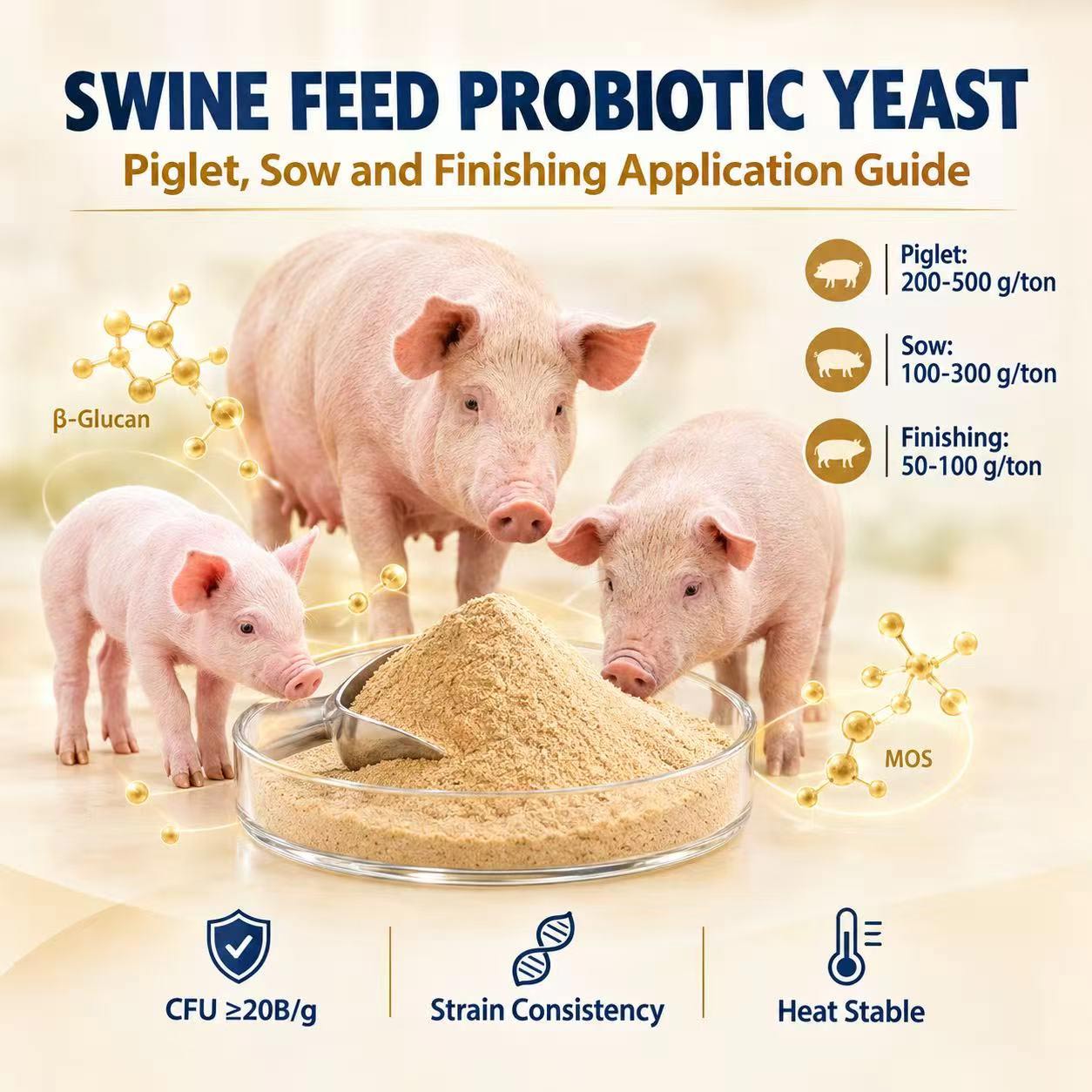
Active dry yeast application guide for swine: piglet post-weanin...
Hotline+86 13821675082
Product Details
Among all livestock species, swine consumes more yeast-based probiotic and functional feed ingredients than any other. The reason is straightforward: commercial pig production is the most intensively managed livestock system in the world. Piglets are weaned at 14–21 days — far earlier than their biological readiness. Sows are pushed to extreme lactation output. Finishing pigs are grown to market weight in as little as 150 days. At every stage, the animal is under nutritional, environmental, and immune stress. And at every stage, yeast-based ingredients have a measurable role to play.
Post-weaning diarrhea remains one of the most costly conditions in global pig production. It affects 15–25% of nursery piglets in commercial systems, increases mortality, reduces growth rate, and drives antibiotic use. As antibiotic growth promoter (AGP) restrictions tighten across North America, the European Union, and Asia, producers need natural gut health solutions that work. Active dry yeast and yeast cell wall are among the most well-documented and widely adopted alternatives. The global swine probiotics market, valued at over $1.2 billion in 2024, is projected to grow at a CAGR of 7.8% through 2030 — driven largely by the shift toward yeast-based solutions for nursery pigs.
This guide is written for swine nutritionists, feed mill formulators, and procurement teams who need a practical, species-specific reference: which yeast product to use at which production stage, at what inclusion rate, with what expected outcomes, and how to evaluate supplier specifications. It covers active dry yeast for probiotic gut action, yeast cell wall for immune and pathogen support, and how the two work together in a complete gut health program.
The pig gastrointestinal tract hosts over 500 microbial species. At weaning, the transition from sow's milk to solid feed causes a dramatic ecological disturbance. Lactobacillus and Bifidobacterium populations decline within 48 hours. Enterotoxigenic E. coli (ETEC), Salmonella enterica, and other opportunistic pathogens can overgrow. Intestinal villi shorten by up to 30% during the first week post-weaning, reducing brush-border enzyme activity — including lactase, sucrase, and maltase — and impairing nutrient absorption. The result is diarrhea, reduced feed intake, and impaired growth that can persist for 2–3 weeks.
Live Saccharomyces cerevisiae cells survive gastric transit (pH 2.5–3.5 for up to 4 hours) and reach the small intestine and colon at concentrations of 10⁶–10⁷ CFU/g digesta. There, they exert several effects:
Competitive exclusion: Yeast cells bind to mannose residues on the intestinal epithelium via their cell wall mannoproteins, physically blocking FimH-expressing pathogens from attaching.
Metabolite production: Yeast produces polyamines (spermine, spermidine), B vitamins (B1, B2, B6, folic acid), and glutathione — compounds that support enterocyte proliferation and stabilize gut barrier function.
Oxygen scavenging: Yeast consumes residual oxygen (Klebsiella, E. coli are facultative anaerobes), lowering redox potential (Eh) in the gut lumen from +150 mV to −100 mV — an environment that favors obligate anaerobic beneficial bacteria over facultative anaerobic pathogens.
Modulation of immune response: Yeast cell wall fragments (β-glucan) released during autolysis in the gut stimulate local immune cells via Dectin-1 and TLR-2 receptors, priming the mucosal immune system without causing inflammation.
The cell wall fraction — whether fed separately as a purified product or as part of whole inactive yeast — provides two additional, well-characterized mechanisms:
Beta-glucan immune priming: β-1,3/1,6-glucan is recognized by Dectin-1 receptors on porcine macrophages, neutrophils, and dendritic cells. This activates NF-κB signaling, upregulates TNF-α and IL-6 production at baseline, and primes the innate immune response for faster reaction to pathogenic challenge. In weaning piglets, this reduces the severity of ETEC-induced diarrhea by lowering intestinal inflammation while maintaining productive growth.
MOS pathogen binding: Mannan oligosaccharides (MOS) mimic the mannose-containing glycoproteins on the pig intestinal epithelium. Type-1 fimbriae on E. coli and Salmonella bind to MOS instead of the gut wall. The pathogen-MOS complex is then flushed out with digesta. Research has shown that MOS at 0.2% inclusion can reduce Salmonella colonization in piglets by 30–40% without affecting commensal E. coli populations.
Together, active yeast and cell wall provide three layers of gut defense: physical competitive exclusion, immune priming, and pathogen decoy. This is why many commercial programs combine both rather than relying on one product alone.
Weaning is the single most stressful event in commercial pig production. Piglets are separated from the sow, moved to a new pen, mixed with unfamiliar littermates, and switched from a highly digestible milk diet to a complex solid feed — all within hours. The gut microbiome collapses within 48 hours. Post-weaning diarrhea (PWD) caused by ETEC (expressing K88, K99, or F18 fimbriae) is the most common clinical outcome, affecting 15–25% of nursery piglets.
The economic impact is substantial. Affected piglets grow 15–30% slower through the nursery phase, require medication, and have mortality rates of 3–8% versus 1–2% in unaffected litters. For producers running 10,000-sow farms, even a 5% reduction in PWD incidence translates to 200–300 additional marketable pigs per year — worth $40,000–$60,000 annually at current U.S. prices. This is why nursery piglets represent the highest ROI stage for yeast probiotic inclusion.
For active dry yeast (feed-grade S. cerevisiae, ≥20 billion CFU/g at manufacture):
Nursery phase (7–25 kg): 200–500 grams per metric ton of complete feed. Start 3–5 days before weaning and continue through the full nursery phase (approximately 6–8 weeks).
Starter phase (0–7 days post-weaning): 400–500 g/ton during the first week when stress is greatest. Reduce to 200–300 g/ton for weeks 2–8 of the nursery phase.
For yeast cell wall (beta-glucan 30–50%, MOS 20–30%, enzymatic extraction):
Nursery phase: 100–200 grams per metric ton, used alongside active dry yeast in a combined program. The combination provides live probiotic action plus immune/pathogen support at a total inclusion cost that is lower than using either product alone at high inclusion.
When implemented correctly, producers report the following outcomes, consistent with published peer-reviewed research:
20–40% reduction in post-weaning diarrhea incidence (meta-analysis of 14 nursery trials, Journal of Animal Science, 2023)
5–15% improvement in nursery average daily gain (ADG) across the first 4 weeks post-weaning
8–12% improvement in feed conversion ratio during the starter phase
Reduced medication cost: 30–50% lower usage of zinc oxide alternatives and antibiotic treatments
More uniform litter performance and lower cull rate (from 5–7% to 2–3%)
Improved feed intake during the critical first week post-weaning — the most predictive window for final nursery weight
These outcomes are consistent across commercial herds in North America, Europe, and Asia. The degree of improvement depends on baseline herd health, diet formulation (particularly the level of fermentable fiber and protein), and management quality — yeast is a foundation, not a replacement for good pig production practices.
Start supplementation before weaning, not after. The first 48 hours post-weaning is when gut disruption occurs — waiting until diarrhea appears is too late.
Ensure the yeast survives feed processing. Active dry yeast tolerates standard pelleting at die temperatures up to 75°C at 15–20% moisture. For higher-temperature pelleting (85°C+), use post-pellet liquid application or a heat-protected microencapsulated product.
Maintain consistent inclusion. Yeast effects are cumulative — switching rates week to week reduces the benefit.
Store active dry yeast below 25°C in a sealed container. At 30°C, viable count declines by approximately 1 log (90%) per 6 months. At 35°C with 60% humidity, the decline accelerates to 1 log per 3 months.
Verify CFU at delivery. Require a certificate of analysis with the production date and plate count result. A "guaranteed minimum" CFU on the label is not the same as a tested value.
Sows are under constant metabolic stress. During late gestation and lactation, they consume massive amounts of feed while mobilizing body reserves. Gut health directly affects feed intake, milk production, and farrowing performance. Constipation affects up to 40% of gestation sows in late pregnancy, reducing comfort and increasing the risk of farrowing complications. Reduced lactation feed intake limits milk yield and piglet growth.
Yeast supplementation in sow diets addresses several of these challenges through the same mechanisms — competitive exclusion, immune modulation, and metabolite production — but at lower inclusion rates because the adult sow gut is more stable:
Improved gut motility and reduced constipation in late gestation, leading to shorter farrowing intervals and lower stillbirth rates
Higher lactation feed intake (reported improvement of 0.3–0.6 kg/day), supporting milk yield and reducing sow body condition loss
Enhanced transfer of immune factors (IgA) and beneficial bacteria (Lactobacillus, Bifidobacterium) to piglets through colostrum
Reduced stress-related gut disturbances around farrowing, particularly in high-parity sows
For active dry yeast:
Gestation diet: 100–200 grams per metric ton
Lactation diet: 200–300 grams per metric ton
Start: Introduce during late gestation (approximately day 85–90) and continue through weaning. This ensures the sow's gut microbiome is optimized before farrowing.
For yeast cell wall:
Gestation and lactation: 100–150 grams per metric ton, particularly in herds with documented Salmonella pressure or immune challenge. The MOS fraction also reduces pathogen shedding into the environment, improving barn hygiene over time.
Improved sow body condition through lactation (reduced backfat loss by 1–2 mm)
Higher milk yield (reported 5–8% increase) and milk fat content, directly contributing to heavier piglet weaning weights
Heavier weaning weights: 0.2–0.5 kg heavier per piglet at 21 days, and more uniform litters
Reduced sow mortality and cull rate, particularly in high-parity sows
Potential improvement in subsequent farrowing performance (return-to-estrus interval, litter size at next parity)
The maternal transfer effect is worth emphasizing: beneficial bacteria and immune factors from the sow's gut microbiome are transferred to piglets through colostrum within the first 24 hours after birth. A healthier sow gut means a healthier piglet gut from day one — reducing the need for aggressive intervention post-weaning and creating a compounding benefit across parities.
The finishing phase (approximately 25–120 kg live weight) is where the bulk of feed cost is incurred. Feed represents 60–70% of total production cost in finishing pigs, and the FCR for this phase typically ranges from 2.6:1 to 3.2:1. A 5% improvement in FCR across 1,000 finishing pigs translates to approximately $15,000–$20,000 in feed savings per turn.
While active dry yeast at finishing-phase inclusion rates does not deliver the dramatic gut health benefits seen in piglets, it contributes to consistent gut function, nutrient absorption, and feed efficiency throughout the grow-out period. The mature pig gut is more stable, but it is not immune to stress — particularly during seasonal heat, disease challenge, and diet transitions between grower and finisher phases.
For active dry yeast:
Finishing diet (25–120 kg): 50–100 grams per metric ton. This is a maintenance-level inclusion, lower than nursery and sow rates, reflecting the lower stress and more mature gut of finishing pigs.
For yeast cell wall:
Finishing diet: 50–100 grams per metric ton, primarily in herds with documented pathogen pressure or during periods of environmental stress (e.g., seasonal heat above 28°C, PRRS or circovirus challenge, diet transition phases).
1–3% improvement in FCR across the finishing phase
More consistent growth curves and reduced weight variation at marketing (lower CV from 8–10% to 5–7%)
Lower mortality during the late finishing period (from 2–3% to 1–1.5%)
Reduced medication usage in high-density finishing barns
Improved carcass quality metrics (leanness, backfat) indirectly through better nutrient absorption
The finishing phase is where cost sensitivity is highest. At 50–100 g/ton inclusion, active dry yeast adds approximately $0.30–$0.60 per metric ton of feed cost — a minimal investment relative to the FCR improvement it supports. For producers running year-round programs, the finishing inclusion is the lowest-cost component of a three-stage yeast program.
The most effective commercial swine gut health programs combine active dry yeast and yeast cell wall rather than relying on either alone. The two products address different mechanisms and operate at different points in the gut:
| Component | Active Mechanism | Gut Location | Primary Benefit |
|---|---|---|---|
| Active dry yeast (live cells) | Competitive exclusion, oxygen scavenging, metabolite production (polyamines, B vitamins, glutathione) | Small intestine and colon | Live gut flora stabilization, improved nutrient absorption |
| Beta-glucan (cell wall) | Dectin-1 receptor activation, NF-κB priming, macrophage and neutrophil modulation | Mucosal immune cells throughout GI tract | Immune support, reduced inflammation during stress |
| MOS (cell wall) | Type-1 fimbriae binding, pathogen decoy | Small intestine | Reduced ETEC and Salmonella colonization |
A typical combined program for a nursery piglet might use active dry yeast at 300 g/ton plus yeast cell wall at 100 g/ton. This delivers probiotic gut action, immune priming, and pathogen binding in one formulation at a total inclusion cost that is typically 20–30% lower than using active yeast alone at 500 g/ton. The combined benefit is greater than either product alone because the mechanisms are complementary rather than redundant.
For a deeper understanding of the two product types, their classification, and functional parameters, see our overview of yeast probiotic ingredient categories in the animal market.
For active dry yeast used in swine feed, the critical parameters go beyond crude protein:
Viable cell count (CFU/g): Minimum 10–20 billion CFU/g at delivery, verified by plate count (Malt Extract Agar, 30°C, 48 hours). The COA should list the production date and actual tested value, not a "guaranteed minimum."
Strain identity: Feed-grade Saccharomyces cerevisiae selected for gut survival (acid and bile tolerance). Different strains have different adhesion properties and metabolite profiles. Ask for the specific strain name.
Moisture: ≤6% to preserve viability during storage. Above 8%, viability declines rapidly.
Pelleting tolerance: Confirm the product survives your mill's die temperature and conditioning time. Standard active yeast tolerates up to 75°C. For higher-temperature pelleting, request heat-stable or microencapsulated options.
Contaminant limits: Yeast should meet microbial specifications: total plate count ≤10⁸ CFU/g, coliforms absent, Salmonella absent, molds ≤10⁴ CFU/g.
As detailed in our analysis of crude protein alone does not capture yeast functional value, the CFU, strain, and processing tolerance matter far more than the protein number on the COA. A product labeled "45% crude protein" with low viable count and poor pelleting tolerance will underperform regardless of its protein spec.
For cell wall products used in swine:
Beta-glucan content: 30–50% minimum, measured by enzymatic assay (e.g., Megazyme Yeast Beta-Glucan Assay Kit). Do not accept calculations based on total carbohydrate — the enzymatic assay directly measures the β-1,3/1,6-linked glucan fraction.
MOS content: 20–30% minimum, measured by HPLC or mannose release analysis.
Extraction method: Enzymatic or mechanical extraction preferred over harsh chemical (alkali/acid) treatment, which can degrade beta-glucan structure and reduce its Dectin-1 binding activity.
Protein content: Typically 20–30% in cell wall products. This is residual mannoprotein, not the active fraction — do not pay a premium based on protein content.
For a detailed breakdown of these parameters, testing methods, and how to compare cell wall products, see our guide on yeast cell wall beta-glucan and MOS in animal feed.
For swine producers running multi-stage programs, batch-to-batch consistency is essential. A nursery diet that receives 300 g/ton of active yeast with varying CFU levels (e.g., 20 billion in batch A and 8 billion in batch B) will produce variable piglet performance and makes it impossible to validate the program's effectiveness.
Require per-batch COAs showing actual viable count, not just label claims. For U.S. producers, ensure the supplier can meet AAFCO ingredient naming and documentation requirements. For EU producers, verify compliance with Regulation (EC) No 1831/2003 on feed additives. For Asian markets, confirm registration status with the relevant national authority (e.g., MAFRA in Korea, MOA in China, NAFIQAD in Vietnam). See our analysis of batch stability and AAFCO compliance for a detailed checklist.
The most common mistake is waiting until diarrhea appears before starting yeast supplementation. By that point, the gut microbiome is already disrupted and the inflammatory cascade is underway. The correct approach is to start 3–5 days before weaning and continue consistently. Producers who wait for clinical signs see 50–70% less benefit than those who start prophylactically.
Heat-inactivated brewer's yeast provides nutrition (protein, B vitamins, nucleotides) but no live probiotic action. If the goal is gut flora stabilization, the product must contain viable cells meeting the CFU specification. If the goal is protein and B-vitamin supplementation as a nutritional ingredient, inactive yeast is appropriate — but it is not a probiotic and should not be expected to deliver competitive exclusion or oxygen scavenging benefits.
Active dry yeast loses viability when exposed to heat and moisture. A product stored in a feed mill warehouse at 35°C for two months will have lost approximately 90% of its viable count (1 log reduction) compared to the COA. Store sealed, cool (below 25°C), and use within the stated shelf life (typically 18–24 months from manufacture when properly stored). Rotate stock — oldest inventory first.
Yeast effects are cumulative. The gut microbiome takes 7–14 days to stabilize after dietary intervention. A two-week trial is not enough to evaluate performance. A full nursery phase (6–8 weeks) or a complete sow cycle (145 days gestation + 21 days lactation) is the minimum evaluation period. Evaluate using consistent metrics: diarrhea scores, ADG, FCR, and medication costs — not subjective observations.
The cheapest active yeast per kilogram may deliver half the viable count of a slightly more expensive product. Calculate effective cost per delivered CFU, not per bag. For example: Product A at $5/kg with 10 billion CFU/g delivers 10¹³ CFU per dollar. Product B at $7/kg with 20 billion CFU/g delivers 2.86 × 10¹³ CFU per dollar — a 2.86× better value despite the higher unit price. For regional procurement guidance including import documentation and regulatory requirements, see our guide on active dry yeast procurement for Southeast Asian feed mills.
Yeast performance is modulated by diet composition. High levels of fermentable protein (e.g., animal plasma, dried whey) and certain fiber sources can enhance or reduce yeast efficacy. A diet with adequate fermentable carbohydrates (lactose, sucrose in the starter phase) provides substrate for beneficial bacteria that yeast helps to establish. Consult with a swine nutritionist to ensure the yeast program is coordinated with overall diet formulation, not added as a standalone afterthought.
For feed mills evaluating yeast suppliers, the following quality indicators differentiate reliable partners from commodity suppliers:
In-house fermentation capability: Suppliers who control fermentation (rather than buying off-spec brewer's yeast byproduct) can guarantee strain consistency, CFU levels, and contaminant control.
Per-batch COA with actual values: Every shipment should include a COA listing tested CFU, moisture, ash, protein, beta-glucan (for cell wall products), microbial safety, and heavy metals.
Traceability: The supplier should be able to trace each batch back to its fermentation date, raw material source, and production line.
Trial support: Reliable suppliers offer trial-order programs (from 100 kg to 1 ton) and technical support for formulation and on-farm evaluation.
Regulatory compliance documentation: AAFCO-compliant ingredient definitions, FDA feed facility registration, ISO 22000 or FSSC 22000 certification, and COA templates that meet buyer QA requirements.
These indicators matter because yeast probiotic performance is a function of consistent delivery of viable, correctly identified cells at the specified CFU — not the price per kilogram. A supplier who cannot provide per-batch functional data is not a compliance risk; they are a formulation risk.
Swine is the largest market for yeast probiotics because it is where gut health challenges are most acute and where every percentage point of FCR or diarrhea reduction translates directly to dollars. The product category is mature, the mechanisms are well understood through decades of research, and the inclusion rates are established across nursery, sow, and finishing phases.
The key to success is matching the right product to the right production stage: active dry yeast at 200–500 g/ton for piglets, 100–300 g/ton for sows, and 50–100 g/ton for finishing pigs, combined with yeast cell wall at 100–200 g/ton where immune and pathogen support is needed. Start early at weaning, verify CFU and beta-glucan/MOS parameters on every COA, maintain consistent inclusion, and store product correctly.
For swine nutritionists and feed mill procurement teams, the practical takeaway is straightforward: the barn performance — not the COA protein number — is the ultimate measure of whether the program is working. Evaluate using consistent metrics over a full production phase, and choose suppliers who provide per-batch functional data rather than label claims.
Q: How much active dry yeast should be used in piglet feed?
A: 200–500 grams per metric ton of nursery feed. Start 3–5 days before weaning at 400–500 g/ton for the first week, then reduce to 200–300 g/ton through weeks 2–8 of the nursery phase. Add yeast cell wall at 100–200 g/ton for combined immune and pathogen support.
Q: Can yeast replace antibiotics in pig production?
A: Yeast does not directly replace therapeutic antibiotics for disease treatment. It supports gut health and immune function as part of an antibiotic reduction program, particularly in nursery pigs. It works best as a foundation alongside good nutrition, hygiene, and biosecurity — not as a standalone replacement. Zinc oxide replacement programs typically combine yeast with organic acids, essential oils, and optimized diet formulation.
Q: What is the inclusion rate for sows?
A: 100–200 g/ton in gestation diet, 200–300 g/ton in lactation diet. Start at day 85–90 of gestation and continue through weaning. Add yeast cell wall at 100–150 g/ton where Salmonella pressure or immune challenge is documented.
Q: Does active dry yeast survive pelleting?
A: Yes, at standard die temperatures up to 75°C with conditioning moisture at 15–20%. For higher-temperature pelleting (85°C+), use post-pellet liquid application or a microencapsulated product. Yeast cell wall products are completely heat-stable and require no special handling during processing.
Q: What is the expected ROI for a yeast program in nursery pigs?
A: Typical ROI ranges from 3:1 to 6:1 when calculated across reduced medication cost, improved ADG, and lower mortality. A program costing $0.50–$1.00 per ton of nursery feed typically returns $2–$6 per ton through performance improvements. Results vary by baseline herd health and management quality.