
Focus on Feed Additions Global Supply
-13 Years in the Feed Additives Market.
Hotline+86 13821675082
Focus on Feed Additions Global Supply
-13 Years in the Feed Additives Market.

 Hotline +86 13821675082
Tel:+8613661236356
Email:sales@yeastpowderco.com
Add:Rm603 Central building, Xinmao Huayuan Park, Xiqing Dist., Tianjin China-300392
application
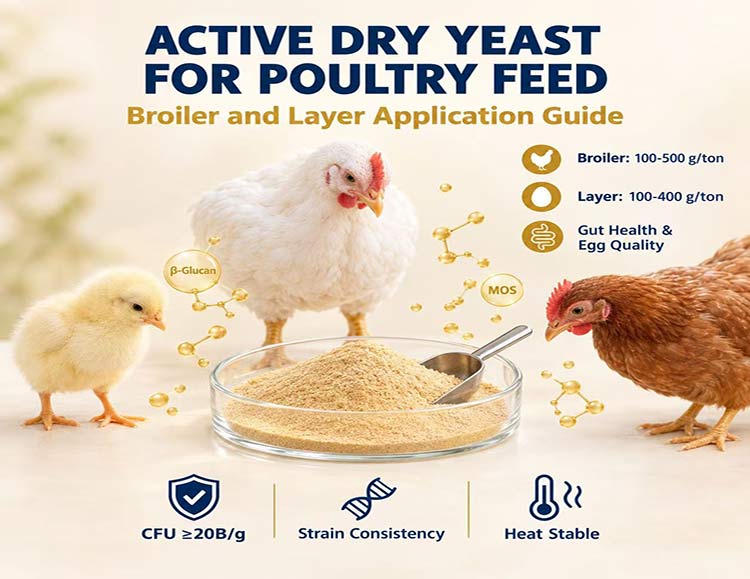
Active dry yeast for poultry feed: broiler gut health, layer egg...
Hotline+86 13821675082
Product Details
Poultry is the largest species group in most feed mills’ order books, and it is also the group in which small changes in gut health show up fastest in the numbers: mortality, feed conversion, flock uniformity, litter condition and egg quality. Broilers reach market weight in roughly five to six weeks, so a gut disturbance in the first ten days can leave a mark that never fully recovers. Layers and breeders are kept for many months, so low-grade gut stress can erode persistency and shell quality long before it becomes visible as disease.
Active dry yeast (Saccharomyces cerevisiae) is used in poultry feed for three practical reasons. It is a live, single-strain microbial ingredient with a well-understood safety profile; its cell wall delivers beta-glucans and mannan oligosaccharides (MOS) with documented interactions with the immune system and with pathogens; and it fits into programs that reduce reliance on routine antibiotics, which many export markets now expect.
This guide explains the mechanisms behind yeast use in poultry, sets out stage-by-stage inclusion ranges for broilers and layers, describes how to combine live yeast with yeast cell wall, and lists the procurement parameters that separate a functional product from one that only looks right on paper. For a wider view of the product categories, see yeast probiotic ingredient categories in the animal market.
Scope note: inclusion rates below are typical working ranges for planning and discussion. Final rates should be set by the formulator based on the product’s measured CFU, the pelleting conditions, the disease challenge and the flock’s performance targets.
The poultry digestive tract is short and fast. Feed passes from beak to vent in a matter of hours, and the ceca, where much of the microbial activity concentrates, are colonized quickly after hatch. This speed shapes what yeast can and cannot do. It does not “replace” the gut flora. It acts as a stabilizing input during the period when the flora is still being established, and again during stress events when the balance is disturbed.
Many enteric bacteria, including Salmonella and pathogenic E. coli, attach to the intestinal lining through type-1 fimbriae, whose tip adhesin (FimH) binds mannose residues. The mannan fraction of the yeast cell wall presents mannose-rich structures that can act as a decoy: bacteria bind to the yeast-derived material and are carried out with the digesta rather than colonizing the epithelium. This is the basis for MOS use in poultry. The mechanism applies to bacteria with mannose-sensitive adhesion; it does not apply to every pathogen, which is one reason yeast is a component of a program rather than a stand-alone solution.
The inner cell wall layer contains beta-1,3/1,6-glucan. Immune cells carry pattern-recognition receptors, such as Dectin-1, that recognize these structures. Controlled, low-level stimulation can keep the innate immune system responsive without triggering a damaging inflammatory response. In young birds, whose adaptive immunity is still developing, this background priming is of particular interest. Responses depend on the glucan content and structure, which is why the source and processing of the yeast matter. See yeast cell wall beta-glucan and MOS in animal feed for the mechanism in detail.
Live yeast cells are metabolically active when moisture and temperature allow. They consume oxygen, which contributes to a more reduced environment favorable to beneficial anaerobes, and they supply B-vitamins and other metabolites. These effects depend on viable cells reaching the gut, which is why CFU count and survival through pelleting are treated as functional specifications rather than marketing numbers.
Yeast responses are larger when birds face a challenge: high stocking density, heat stress, a change of feed, a coccidiosis vaccine reaction, wet litter, or mycotoxin pressure. On a clean, well-managed farm with low challenge, the margin for visible improvement is smaller. A program should therefore be judged against the flock’s baseline and the challenge it faces, not against a universal number.
Broiler programs are built around the first ten to fourteen days, when gut colonization and early immune development are most sensitive, and around the stress windows that follow, such as vaccination, feed transitions and heat.
| Phase | Typical age | Active dry yeast (g/ton of feed) | Yeast cell wall (g/ton of feed) | Main purpose |
|---|---|---|---|---|
| Starter | Day 0 to 10–14 | 300–500 | 100–200 | Gut colonization, early immune support |
| Grower | Day 11–14 to 24 | 200–400 | 100–150 | Gut stability through feed transitions |
| Finisher | Day 25 to market | 100–300 | 50–100 | Stress buffering, litter and flock uniformity |
This is where the highest rates are usually justified. Chicks hatch with a nearly sterile gut and are colonized by whatever they meet first. Starting yeast in the very first feed helps the flora develop in a more stable direction. Fine particle size matters at this stage, because yeast must mix homogeneously into a small daily intake. Poor mixing at low inclusion rates leads to a situation in which some birds receive almost none.
Rates are often reduced as the gut matures, but they should be raised again around known stress points: vaccination, a coccidiostat withdrawal, a switch to a different ration or a forecast heat wave. Maintaining a lower baseline through the finisher helps hold litter quality and flock uniformity, both of which are monitored closely by integrators.
Where a producer is moving toward reduced or no routine antibiotic use, yeast works best as one part of a package that also includes biosecurity, water quality, organic acids or other gut-support ingredients, and careful management of litter and ventilation. Yeast should be introduced several weeks before the antibiotic reduction, so performance can be compared on a like-for-like basis.
Cumulative mortality, especially in the first week
Feed conversion ratio and average daily gain, corrected for body weight
Flock uniformity at slaughter age
Litter moisture and footpad condition
Treatment days and medication cost per flock
Comparing at least three consecutive flocks under the same management, rather than a single batch, gives a more reliable picture than any single result.
Layers are managed for persistency: keeping production high and shell quality stable for as long as possible. Gut health affects this through nutrient absorption, particularly calcium and phosphorus utilization, and through the metabolic load that disease or stress places on the hen.
| Phase | Active dry yeast (g/ton of feed) | Yeast cell wall (g/ton of feed) | Main purpose |
|---|---|---|---|
| Pullet rearing | 200–400 | 100–150 | Gut development, vaccine response, uniformity |
| Pre-lay and peak production | 200–300 | 100–200 | Absorption efficiency, persistency |
| Late lay | 100–300 | 100–150 | Shell quality, stress buffering |
| Breeders | 200–300 | 100–150 | Hen health, hatchability support |
The pullet period determines how well the bird will perform for the next year. Uniformity at the point of lay is one of the strongest predictors of a good flock. Yeast programs in rearing focus on supporting gut development and the response to vaccines.
In laying hens, the targets are persistency, egg mass, shell strength and feed efficiency. Producers typically monitor egg mass, percentage of cracked or downgraded eggs, shell breaking strength and Haugh units. Late-lay flocks, where shell quality declines, are a common place to trial yeast, because the effect is easy to see and the cost of downgraded eggs is clear.
Heat stress reduces feed intake, changes gut permeability and increases the load on the immune system. Programs that increase yeast and yeast cell wall during hot months, as part of a wider strategy that includes ventilation, water management and electrolyte supply, are a common application in tropical and subtropical markets.
For breeders, gut health supports the hen’s own health and egg quality. Trials focused on hatchability and early chick performance should be run over several flocks, because variation between flocks and between ages is often larger than the treatment effect.
Active dry yeast and yeast cell wall are not interchangeable. They contribute different things and are often used together.
Active dry yeast supplies viable cells, with the gut-environment effects described above, plus the cell wall components of the intact cell.
Yeast cell wall is a concentrated source of beta-glucan and MOS. It does not depend on viability, so it is stable through harsh pelleting and long storage.
A practical way to think about it: live yeast addresses the gut environment, while the cell wall provides a more concentrated and heat-stable dose of the binding and immune-modulating fractions. During periods of high challenge, such as the first week of life, vaccination, or hot weather, adding cell wall to a live yeast program can be more reliable than raising the live yeast rate alone. The same logic applies in other species; the swine version is described in stage-by-stage swine yeast application guidance.
When both are used, the formulator should account for the actual beta-glucan and MOS content of the cell wall product on the certificate of analysis, rather than assuming that all yeast cell wall products are equivalent. Extraction method and processing determine the active fraction.
A feed mill can specify “active dry yeast” on a purchase order and still receive a product that does little in the bird. The following parameters should be written into the specification and checked on arrival.
| Parameter | What to specify | Why it matters |
|---|---|---|
| Viable count (CFU/g) | Minimum viable count, verified on arrival by a defined plate-count method | Sets the number of live cells delivered per tonne of feed |
| Strain identity | Saccharomyces cerevisiae, single defined strain | Strain consistency drives batch-to-batch function |
| Moisture | Maximum moisture, typically 6% or below | High moisture shortens shelf life and reduces viability in storage |
| Pelleting tolerance | Documented survival at the mill’s conditioning and die temperature | Live cells are heat-sensitive; survival determines the delivered dose |
| Microbial safety | Salmonella not detected in the test portion; limits for other contaminants | Feed safety and export compliance |
| Contaminants | Heavy metal and mycotoxin results per destination-market rules | Regulatory compliance and bird health |
| Certificate of analysis | A lot-specific COA with every shipment | Traceability and verification |
Because the active ingredient is a live cell, the inclusion rate in grams does not tell the full story. The dose should be calculated from the measured CFU. As an example, a product with 20 billion CFU/g (2 × 10¹⁰) added at 300 g/ton supplies 6 × 10¹² CFU per ton, which is 6 × 10⁶ CFU per gram of finished feed before any pelleting loss. A product at half the CFU supplies half the live cells at the same gram rate. This is why two products priced per kilogram can differ widely in cost per delivered dose.
Most poultry feed is pelleted. Conditioning temperature, residence time and die temperature all affect yeast survival. Live yeast products designed for pelleted feed are typically specified for tolerance up to about 75°C die temperature, but this should be confirmed under the mill’s own conditions by comparing CFU in the mash and in the finished pellet. Where pelleting conditions are more severe, post-pellet application or a higher proportion of heat-stable cell wall can be considered.
Yeast is added at low rates, so premix design matters. Use a carrier with appropriate particle size, follow a documented mixing sequence, and run mixer-uniformity tests. Store the product sealed, cool and dry, away from direct sunlight and from sources of moisture.
For a more detailed discussion of how consistency across lots is controlled and verified, see batch stability and AAFCO compliance.
Buying on crude protein or price per kilogram. For a live yeast, the functional specification is viable count and strain, not protein. Price should be compared per delivered billion CFU.
Using the same rate in every phase. A flat rate wastes product in low-risk periods and under-delivers during stress. Plan rates around the starter phase, vaccination and heat.
Ignoring pelleting loss. A product that meets its CFU specification at the factory may deliver much less after conditioning and the die. Test the finished feed.
Judging results on one flock. Poultry performance varies with chick quality, season, disease pressure and management. Compare multiple flocks under the same conditions.
Treating yeast as an antibiotic substitute. Yeast supports gut stability. It does not treat an active infection. Programs that ignore biosecurity, water quality and ventilation tend to disappoint.
Assuming all cell wall products are the same. Beta-glucan and MOS content differ with the source and extraction method. Ask for the analytical values and the method used.
A reliable yeast supplier can show how its product is controlled from the fermenter to the bag. Useful questions include:
Is a single, defined S. cerevisiae strain used, and is strain identity maintained across production runs?
Is viable count measured on every lot, using a stated method, and reported on the COA?
What drying process is used, and how is viability retained through drying and storage?
What is the documented shelf life, and under what storage conditions?
What is the packaging, and does it protect against moisture?
Are heavy metals, mycotoxins and pathogens tested, and are results available per lot?
Will the supplier support a small trial order so that CFU and pelleting survival can be verified before a larger commitment?
Anqirui produces active dry yeast, brewer’s yeast powder, yeast cell wall and related yeast products at partner fermentation facilities in China, and works with feed mills on lot-level documentation and verification. For feed mills in Southeast Asia, see active dry yeast procurement for Southeast Asian feed mills, which covers import documentation and species-specific rates for poultry, swine and shrimp. A technical white paper on specification and verification is available on request.
Use yeast where its mechanisms matter most: the first two weeks of life, vaccination and feed transitions, heat stress, and late-lay shell quality.
Set inclusion by phase, and calculate the dose from measured CFU rather than from grams alone.
Combine live yeast with yeast cell wall when challenge is high or pelleting is severe.
Specify viable count, strain, moisture, pelleting tolerance and contaminant limits, and ask for a lot-specific COA.
Verify CFU in the finished feed, and judge performance over several flocks against a defined baseline.
Working ranges are commonly 300–500 g/ton in the starter phase, 200–400 g/ton in the grower phase and 100–300 g/ton in the finisher phase, for a product at around 20 billion CFU/g. The rate should be adjusted to the product’s measured CFU, the pelleting conditions and the disease challenge.
Survival depends on conditioning temperature, residence time and die temperature. Products formulated for pelleted feed are generally specified for tolerance up to about 75°C, but the only reliable answer is to compare CFU in mash and in pellets under the mill’s own conditions.
Live yeast supports the gut environment and delivers cell wall components within the intact cell. Yeast cell wall provides a concentrated, heat-stable source of beta-glucan and MOS. Many programs use both, with more weight on the cell wall during high-challenge periods or where pelleting is severe.
No. Yeast supports gut stability and can be one part of a program that reduces reliance on routine antibiotics. It does not treat an active infection and works best alongside good biosecurity, water quality and management.
Early-life effects, such as first-week mortality and early flock uniformity, can be seen within a single broiler cycle. Effects on layer persistency and shell quality develop over weeks and should be assessed across a laying period, ideally against a comparable control flock.