Focus on Feed Additions Global Supply
-13 Years in the Feed Additives Market.
Hotline+86 13821675082
Focus on Feed Additions Global Supply
-13 Years in the Feed Additives Market.

 Hotline +86 13821675082
Tel:+8613661236356
Email:sales@yeastpowderco.com
Add:Rm603 Central building, Xinmao Huayuan Park, Xiqing Dist., Tianjin China-300392
Feed yeast market guide: how feed mills choose between active dr...
Hotline+86 13821675082
Product Details
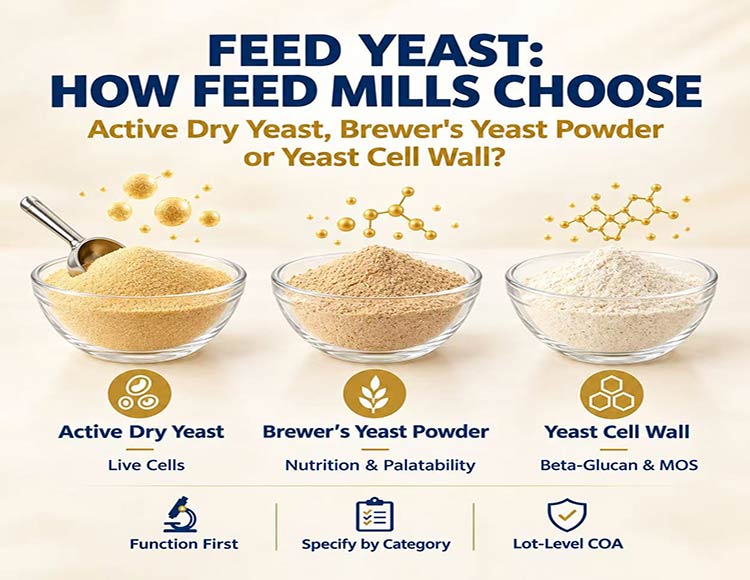
A purchase request that reads “feed yeast” can describe three very different materials. Active dry yeast supplies live cells to the gut. Brewer’s yeast powder supplies nutrients and palatability. Yeast cell wall supplies concentrated, heat-stable fractions that bind and signal. All three come from the same family of organisms, and all three are sold under the same word, but they solve different problems and are judged by different specifications.
When a feed mill treats them as one category, the usual result is a mismatch: a product bought for gut function that was never meant to carry live cells, or a product bought for protein that is expected to deliver an immune effect. This article sets out what each type does, how the three differ, and how a feed mill can choose between them by function, species and specification.
This is a selection framework, not a market forecast. For market and procurement trends, see yeast probiotic ingredient trends and procurement.
Three habits explain most of the confusion.
One word covers many products. “Yeast powder” is used for live, heat-killed, autolyzed and fractionated materials, and the word on the order does not tell the supplier which one is wanted.
Crude protein is the default comparison. It is easy to read from a specification sheet, so it becomes the basis for price comparison even when the product is meant to work by another mechanism. The limits of that approach are covered in why crude protein alone misleads feed buyers.
Price is compared per kilogram. For a live product the relevant unit is viable cells delivered; for a cell wall product it is beta-glucan and mannan content; for a nutritional product it is the amino acid and nutrient profile. A per-kilogram price hides all three.
Active dry yeast (Saccharomyces cerevisiae) is dried under conditions that keep the cells viable. Its function depends on live cells reaching the animal and, for pelleted feed, on those cells surviving conditioning and the die.
Viable cells that consume oxygen and support an environment favorable to beneficial anaerobes
B-vitamins and metabolites produced by active cells
The cell wall components of the intact cell, including beta-glucan and mannan
Programs that aim to stabilize the gut during colonization or stress: young animals, feed transitions, vaccination, heat. The effect is conditional on challenge and management, so results are judged against a flock or herd baseline rather than a universal number.
Viable count (CFU/g), verified on arrival by a defined plate-count method
A single defined strain, consistent between lots
Low moisture, which protects viability in storage
Documented survival under the mill’s pelleting conditions
The difference between live and heat-killed material is covered in more detail in the article on active dry yeast versus inactive yeast in animal feed.
Brewer’s yeast powder is typically made from yeast that has been used in brewing, then inactivated and dried. It is not selected for viable cells. It is selected for what the material contains: protein, amino acids, B-vitamins, nucleotides and other cell components.
A nutrient profile with protein, amino acids and B-vitamins
Palatability support, which matters in pet food and in feed for young animals
Cell wall components, in an unfractionated form
Formulations where the goal is nutritional contribution and acceptance: pet food, specialty and companion-animal products, and feed for young animals where intake is a limiting factor.
Protein and amino acid profile, read together rather than crude protein alone
Consistency between lots, since brewing by-products can vary by source and processing
Moisture, ash and contaminant results
Microbiological safety
Because the material is inactivated, CFU is not a relevant specification, and a product sold on a CFU claim should be questioned. Batch-to-batch control is covered in batch stability and AAFCO compliance for brewer’s yeast.
Yeast cell wall is the fraction left after the cell contents are separated from the wall. It is a concentrated source of beta-glucan and mannan oligosaccharides (MOS). Because its function does not depend on viability, it is stable through harsh pelleting and long storage.
Beta-1,3/1,6-glucan, recognized by immune receptors such as Dectin-1
Mannan structures that can bind bacteria with mannose-sensitive adhesion
A heat-stable, storage-stable functional fraction
Programs that need a predictable dose of binding and immune-modulating fractions: antibiotic-reduction programs, high-challenge periods, severe pelleting conditions, and formulations where live cells would not survive processing. The mechanisms are described in yeast cell wall beta-glucan and MOS explained.
Measured beta-glucan and MOS content, with the analytical method stated
Extraction and processing method, which determines the active fraction
Particle size and flowability for mixing
Moisture and contaminant results
Not all cell wall products are equivalent. Two products with the same name can differ widely in glucan and mannan content, so the analytical values matter more than the label.
The matrix below links the goal of the formulation to the product type that fits it. In practice, programs often combine two types, and the choice is made by function first and species second.
| Formulation goal | Active dry yeast | Brewer’s yeast powder | Yeast cell wall |
|---|---|---|---|
| Stabilize gut flora in young animals | Primary choice | Not designed for this | Often paired |
| Nutritional contribution (protein, B-vitamins) | Secondary | Primary choice | Not designed for this |
| Palatability and intake | Limited | Primary choice | Not designed for this |
| Predictable beta-glucan and MOS dose | Variable, as part of intact cells | Variable, unfractionated | Primary choice |
| Severe pelleting or long storage | Needs verified survival | Not affected by viability | Stable |
| Antibiotic-reduction programs | Part of a package | Not a primary tool | Often paired with live yeast |
| Pet food | Depends on processing | Common choice | For specific functional claims |
Poultry and swine: live yeast and cell wall are most often combined, with the rate by growth stage. A swine example is in swine yeast application by production stage.
Pet food: brewer’s yeast powder is common for nutrition and acceptance, with cell wall added where a specific function is claimed.
Young animals of any species: the choice is driven by whether the priority is gut colonization, intake or immune support, which are different products.
The same parameter can be essential for one type and irrelevant for another. A specification that is copied between categories tends to be either too loose or beside the point.
| Parameter | Active dry yeast | Brewer’s yeast powder | Yeast cell wall |
|---|---|---|---|
| Viable count (CFU/g) | Essential | Not applicable | Not applicable |
| Strain identity | Essential | Useful for consistency | Useful for consistency |
| Protein and amino acids | Reported | Essential | Reported |
| Beta-glucan and MOS content | Reported | Reported | Essential, with method |
| Moisture | Essential for viability | Essential for storage | Essential for storage |
| Pelleting tolerance | Essential, verified | Rarely limiting | Rarely limiting |
| Contaminants and microbiological safety | Essential | Essential | Essential |
| Lot-specific COA | Essential | Essential | Essential |
Buying cell wall for nutrition. A cell wall product has lost much of the cell contents; it is not a protein source.
Buying brewer’s yeast powder for live-cell function. An inactivated material cannot deliver viable cells, whatever its protein level.
Buying active dry yeast on protein. Protein is not the specification that explains how it works. Viable count and strain are.
Assuming a live product survives pelleting. Conditioning and die temperature reduce viable counts. Verification in the finished feed is the only reliable check.
Comparing across categories on price per kilogram. The three products deliver different things, so a per-kilogram comparison between them is not a comparison of like with like.
Whichever type is chosen, the supplier should be able to provide a lot-specific certificate of analysis that reports the parameters relevant to that category, state the method used for each, and explain how consistency is controlled from one lot to the next. A feed mill can reasonably ask:
Which product type is this, and what is its intended function?
Which parameters are measured on every lot, and by what method?
How is the strain controlled across production runs?
What is the documented shelf life, and under what storage conditions?
Are heavy metals, mycotoxins and pathogens tested per lot?
Anqirui produces active dry yeast, brewer’s yeast powder and yeast cell wall, and provides lot-level documentation for each. A technical white paper on specification and verification is available on request.
“Feed yeast” covers three product types with three different functions: live cells, nutrients and palatability, and concentrated cell wall fractions.
Choose by function first and species second, and combine types where the program calls for it.
Write the specification for the category, because the parameter that is essential for one type can be irrelevant for another.
Compare products on what they deliver: viable cells, nutrient profile or glucan and mannan content, rather than on price per kilogram or crude protein.
Verify in the finished feed where function depends on processing, and ask for lot-specific documentation.
Active dry yeast is dried to keep cells viable, and its function depends on live cells. Brewer’s yeast powder is typically inactivated and is chosen for its nutrient content and palatability. They are not interchangeable.
No. Yeast cell wall is a separated fraction that concentrates beta-glucan and MOS, while brewer’s yeast powder contains the cell contents as well as the wall. They serve different purposes and are specified on different parameters.
Yes. Live yeast and cell wall are commonly combined to cover both the gut environment and a heat-stable dose of functional fractions. The combination depends on the species, the stage and the challenge the animals face.
Brewer’s yeast powder is a common choice for nutrition and acceptance. Cell wall is added where a specific functional claim is made. Live yeast depends on whether the processing conditions allow cells to survive.
Related Recommendations